
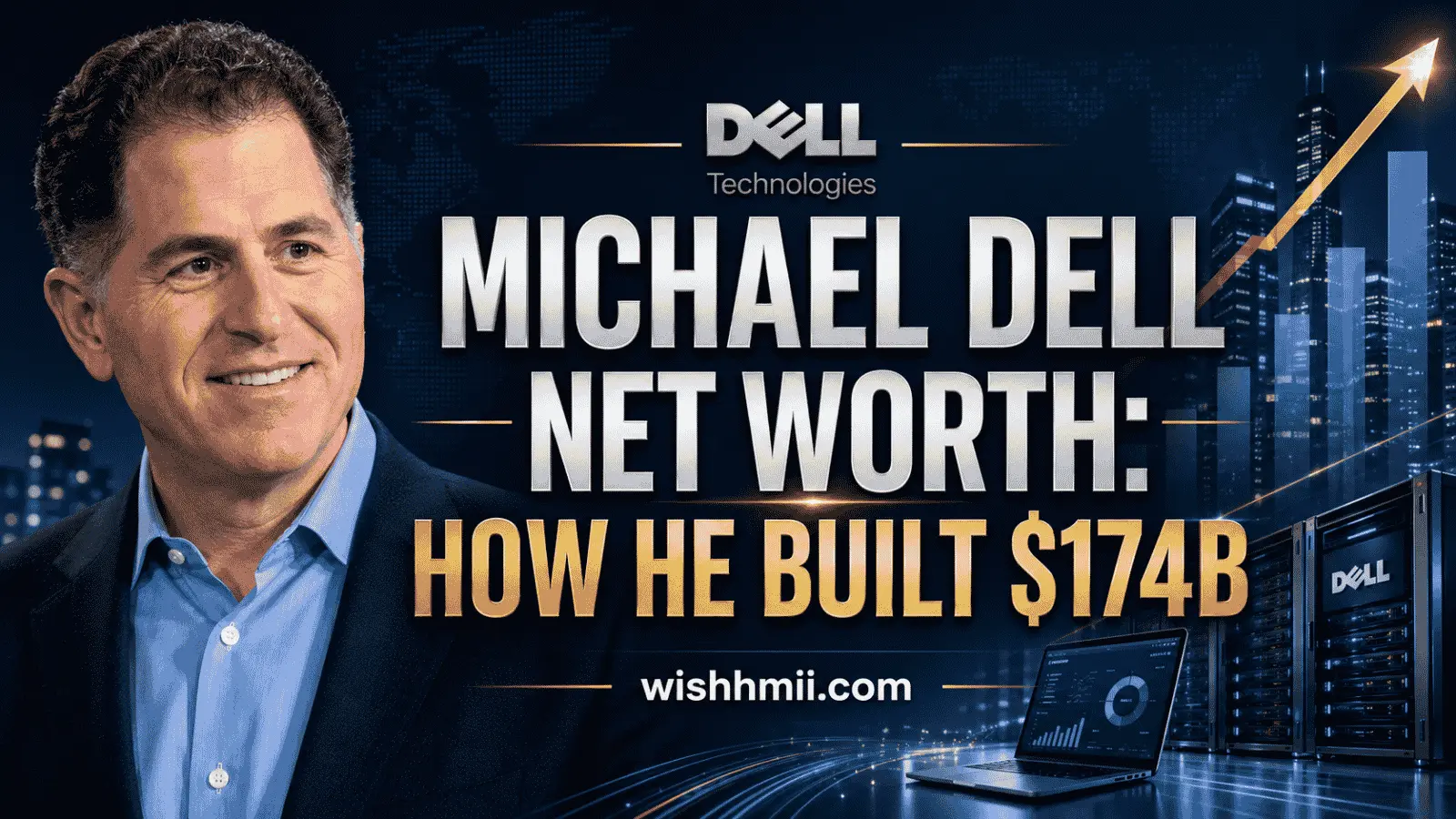
Michael Dell net worth is estimated at about $174 billion, based on the latest publicly available Bloomberg Billionaires Index figure reviewed for this article. That number is not cash sitting in a bank. It is an estimate built from public stock holdings, reported company ownership, Broadcom shares received from the VMware deal, cash, investments, charitable giving, taxes, and market movement.
Michael Dell is best known as the founder, chairman, and CEO of Dell Technologies. He started the company from a college dorm room with $1,000 and turned it into one of the world’s largest technology infrastructure companies. His wealth has grown sharply in the AI era because Dell sells servers, storage, and enterprise technology used by major companies and governments.
This guide covers Michael Dell’s latest estimated net worth, his 2025 vs. 2026 wealth change, income sources, business ownership, salary, assets, ranking, philanthropy, controversies, and why different sources show different numbers.
Quick Answer
Michael Dell is an American technology billionaire, investor, philanthropist, and the founder of Dell Technologies.
His latest publicly available net worth estimate is about $174 billion, with most of his fortune tied to Dell Technologies, Broadcom shares, and investment assets.
His estimates vary because Dell’s public shares and Broadcom-linked wealth move with the stock market, while private investments and taxes are harder to measure.
Net Worth Snapshot Table
| Category | Details |
|---|---|
| Full name | Michael Saul Dell |
| Known as / nickname | Michael Dell |
| Estimated latest net worth | About $174 billion |
| Estimated 2025 net worth | About $143.1 billion on Forbes’ 2025 U.S. rich list; about $140 billion implied by Bloomberg’s 2026 year-to-date change |
| Change in dollars | About +$30.9 billion vs. Forbes’ 2025 estimate; about +$34 billion year-to-date by Bloomberg’s April 2026 figure |
| Change in percentage | About +21.6% vs. Forbes’ 2025 figure; Bloomberg showed +24.3% year-to-date as of April 20, 2026 |
| Main wealth source | Dell Technologies ownership, Broadcom shares from the VMware transaction, private investments |
| Country | United States |
| Industry | Technology |
| Age | 61 |
| Birthday | February 23, 1965 |
| Birthplace | Houston, Texas, U.S. |
| Nationality | American |
| Last updated | April 29, 2026 |
| Confidence level | High for billionaire status and main wealth source; medium for exact dollar estimate |
| Reason for confidence level | Dell’s public company ownership is well documented, but private investments, taxes, gifts, and daily stock moves make the exact total an estimate |
Basic Info
| Detail | Information |
|---|---|
| Full name | Michael Saul Dell |
| Public name | Michael Dell |
| Age | 61 |
| Birthday | February 23, 1965 |
| Birthplace | Houston, Texas |
| Nationality | American |
| Profession | Entrepreneur, CEO, investor, philanthropist |
| Known for | Founding Dell Technologies |
| Main industry | Technology hardware, enterprise IT, AI infrastructure |
| Public status | Public company CEO and billionaire investor |
Michael Dell is one of the richest people in the United States. His wealth is unusual because it comes from a company he started as a teenager and still leads more than four decades later.
Family and Personal Life
Michael Dell is married to Susan Dell. Together, they are widely known for philanthropy through the Michael & Susan Dell Foundation.
Public sources identify his father as Alexander Dell and his mother as Lorraine Dell. Michael Dell and Susan Dell have four children. His brother, Adam Dell, is also publicly known as an entrepreneur and investor.
A privacy note is important here: while Michael Dell is a public figure, many details about his children and private family life are not necessary for understanding his wealth. This article avoids private addresses, children’s personal details, and other sensitive information.
Education
Michael Dell enrolled at the University of Texas at Austin in 1983. He originally planned to study biology and pursue medicine, but he became more interested in selling upgraded personal computers and computer components.
He did not finish his degree. Instead, he left college at age 19 to run what became Dell Computer full time.
His education mattered in an indirect way. The University of Texas gave him access to early customers, a dorm-room base of operations, and a young market of students and professionals who wanted better computers. His practical education came from building, selling, pricing, and shipping computers directly to buyers.
Early Life and Background
Michael Dell grew up in Houston, Texas. He showed business interest early. Public profiles describe him as curious, ambitious, and interested in how markets worked.
His first major business step came at the University of Texas. He began buying computer parts, upgrading machines, and selling them directly to customers. This was important because it avoided traditional retail markups. Dell’s early idea was simple: sell computers directly, customize them for the buyer, and keep costs lower.
That direct-sales model became the core of Dell’s early success.
The turning point came in 1984, when he launched the company with about $1,000. By 1988, Dell went public. By the 1990s, Michael Dell was one of the most famous young CEOs in America.
Career Timeline
| Year | Milestone | What happened | Net worth impact |
|---|---|---|---|
| 1965 | Birth | Michael Saul Dell was born in Houston, Texas | None |
| 1983 | University of Texas | Enrolled at UT Austin and began selling computer upgrades | Created early customer base |
| 1984 | Company launch | Started the business that became Dell Computer with about $1,000 | Foundation of future fortune |
| 1988 | IPO | Dell went public | Turned ownership stake into public equity wealth |
| 1992 | Fortune 500 milestone | Became one of the youngest CEOs to lead a Fortune 500 company | Raised credibility and company value |
| 1996 | Online sales growth | Dell expanded direct sales through the web | Helped scale revenue |
| 2001 | PC market leadership | Dell became a top global PC company | Increased value of founder stake |
| 2004 | CEO transition | Stepped down as CEO but stayed chairman | Less direct operating control |
| 2007 | CEO return | Returned as CEO during business challenges | Rebuilt leadership role |
| 2013 | Dell goes private | Michael Dell and Silver Lake took Dell private | Large control move; reduced public-market pressure |
| 2016 | EMC acquisition | Dell combined with EMC in a major tech deal | Expanded Dell into enterprise infrastructure |
| 2018 | Dell relists | Dell Technologies returned to public markets | Founder stake became easier to value |
| 2021 | VMware spinoff | Dell completed VMware spinoff | Created major value for Dell shareholders |
| 2023 | Broadcom buys VMware | Dell received Broadcom-linked value and cash from the VMware deal | Major wealth driver |
| 2025 | Large philanthropy pledge | Michael and Susan Dell pledged $6.25 billion for children’s investment accounts | Reduced personal/foundation assets but increased philanthropic impact |
| 2026 | AI infrastructure boom | Dell reported record revenue and large AI server demand | Helped lift Dell stock and Michael Dell’s estimated wealth |
Businesses and Ownership
Michael Dell’s wealth comes from several major areas.
Dell Technologies
Dell Technologies is the core of Michael Dell’s fortune. He is founder, chairman, and CEO. Public filings show he owns a large share of the company through Class A and Class C stock, with Bloomberg estimating his Dell ownership at about 40% in late 2025.
Dell Technologies sells:
| Business area | What it includes |
|---|---|
| AI-optimized servers | Systems used for AI workloads and data centers |
| Traditional servers and networking | Enterprise computing infrastructure |
| Storage | Data storage products and services |
| Commercial PCs | Computers for businesses and institutions |
| Consumer PCs | Laptops and desktops for individuals |
| Services and support | Enterprise support, financing, and related services |
Dell’s recent growth is tied to AI infrastructure. In fiscal 2026, Dell reported record full-year revenue of $113.5 billion, up 19% year over year. Its Infrastructure Solutions Group generated $60.8 billion in full-year revenue, up 40%, and AI-optimized server revenue rose sharply.
VMware and Broadcom
Dell Technologies spun off VMware in 2021. Michael Dell owned a large VMware stake after the spinoff. Broadcom completed its VMware acquisition in 2023 in a cash-and-stock transaction.
That deal became a major wealth driver because Dell received Broadcom shares and cash. Bloomberg identifies Broadcom as Michael Dell’s biggest listed asset in its April 2026 profile.
MSD Capital, MSD Partners, and BDT & MSD Partners
Michael Dell created MSD Capital in 1998 to manage family wealth. MSD Partners later merged with BDT & Company in 2023 to form BDT & MSD Partners.
This part of his wealth is harder to value than Dell stock because private investments are not fully public. It likely includes stakes across public markets, private companies, real estate, credit, and other long-term investments.
Michael & Susan Dell Foundation
The Michael & Susan Dell Foundation is not the same as Dell Technologies. It is a charitable foundation created by the Dell family. It focuses on education, health, family economic stability, and child-focused programs.
Philanthropy does not increase personal net worth, but it is important for understanding where some of Dell’s wealth has gone.
Net Worth 2025 vs. Latest Net Worth
| Year / Date | Estimated net worth | Dollar change | Percentage change | Main reason |
|---|---|---|---|---|
| September 2025 Forbes 400 estimate | About $143.1 billion | — | — | Dell stock, Broadcom exposure, investments |
| March 2026 Forbes annual billionaire list | About $141 billion | About -$2.1 billion vs. Forbes 2025 figure | About -1.5% | Different valuation date and market movement |
| April 20, 2026 Bloomberg estimate | About $174 billion | About +$30.9 billion vs. Forbes 2025 figure | About +21.6% | Dell and Broadcom-linked market gains |
| Bloomberg year-to-date figure | About +$34 billion | About +$34 billion | +24.3% | Strong 2026 tech and AI infrastructure gains |
The biggest reason Michael Dell’s wealth increased in 2026 is the market value of his public technology holdings. Dell Technologies benefited from investor excitement around AI infrastructure, especially servers used for artificial intelligence workloads. Broadcom also remained a key part of the estimate because of the VMware deal.
His salary is tiny compared with his stock-based wealth. Dell’s 2025 proxy showed his salary at $950,000 and total compensation of about $3.09 million for fiscal 2025. For a person worth well over $100 billion, salary is not the main driver.
Wealth High and Low
Michael Dell’s recent known high is around the $174 billion Bloomberg estimate from April 20, 2026. This reflected a strong run in tech stocks, Dell’s AI server momentum, and Broadcom-related wealth.
A reasonable recent low range is around $90 billion to $110 billion during weaker market periods before Dell’s AI infrastructure surge and before the full market impact of the Broadcom-VMware transaction became clearer. Exact daily highs and lows depend on the wealth tracker used.
| Wealth point | Estimate | What caused it |
|---|---|---|
| Highest recent public estimate | About $174 billion | Dell stock strength, Broadcom-linked value, AI infrastructure optimism |
| Lower recent range | About $90B–$110B | Lower Dell valuation, market volatility, less AI-server premium |
| 2025 rich-list level | About $143.1 billion | Strong Dell ownership value and Broadcom exposure |
| 2026 Forbes annual list | About $141 billion | Forbes’ March 2026 valuation date and methodology |
| 2026 Bloomberg latest reviewed | About $174 billion | Daily market-based estimate as of April 20, 2026 |
The key point: Michael Dell’s net worth rises and falls mainly with public share prices, not with yearly salary.
Income Sources
| Income source | Estimated value | Frequency | Reliability | Notes |
|---|---|---|---|---|
| Dell Technologies equity | Tens of billions of dollars | Daily market movement | High | Main source of wealth; ownership is supported by filings |
| Broadcom shares from VMware deal | Tens of billions of dollars | Daily market movement | Medium to high | Exact remaining stake is estimated because later holdings are not fully disclosed |
| Cash and investment assets | Multi-billion-dollar range | Ongoing | Medium | Includes sale proceeds, dividends, taxes, donations, and investment performance |
| Dell Technologies salary | $950,000 base salary in fiscal 2025 | Annual | High | Public proxy figure |
| Dell annual incentive / bonus | About $2.09 million in fiscal 2025 | Annual | High | Public proxy figure |
| Dividends | Potentially very large | Quarterly / annual | Medium | Depends on shares held and dividend policy |
| Private investments | Unknown, likely large | Ongoing | Medium to low | Managed through family investment structures and related firms |
| Real estate / resort assets | Publicly reported but not fully transparent | Long term | Medium | Some holdings are public, but full portfolio value is not |
| Book royalties / speaking | Not material to net worth | Occasional | Low | Not a major driver |
| Endorsements / sponsorships | No major public evidence | Not applicable | Low | Not a celebrity endorsement-based fortune |
| Crypto | No reliable public evidence of major holdings | Unknown | Low | Not included in serious estimates |
Property and Assets
Michael Dell has been linked in public reporting to major real estate and resort-related holdings, including high-end Hawaii resort interests and other luxury property assets. Public reports in 2025 described a large land acquisition connected to the Four Seasons Resort Hualalai area and noted Dell’s long-running involvement with major resort properties.
This article does not publish exact private addresses.
His known asset categories include:
| Asset type | Public detail | Estimated value |
|---|---|---|
| Dell Technologies shares | Large founder stake | Tens of billions |
| Broadcom-linked shares | Connected to VMware sale | Tens of billions |
| Cash and investment assets | Based on proceeds, dividends, taxes, donations, and market gains | Multi-billion-dollar range |
| Private investment vehicles | MSD Capital / BDT & MSD Partners-related investments | Not fully public |
| Real estate / resorts | Publicly reported high-end resort and property interests | Public reports suggest hundreds of millions in some transactions |
| Cars / personal luxury items | Limited reliable public detail | Not central to net worth |
| Jets / yachts | Not enough reliable detail for a firm estimate | Not included as major calculation item |
The most important assets are not cars or homes. They are equity stakes.
Lifestyle
Michael Dell appears to live like an ultra-high-net-worth technology founder, but his public image is more business-focused than celebrity-focused.
His lifestyle coverage usually centers on:
| Area | What is publicly supported |
|---|---|
| Homes and real estate | Public reporting links him to major luxury real estate and resort interests |
| Travel | Likely extensive due to business and philanthropy, but details are not central |
| Cars | Not enough reliable public reporting for a serious estimate |
| Fashion | No major public wealth story here |
| Philanthropy | Very significant and well documented |
| Public spending habits | More associated with long-term investments and giving than celebrity-style spending |
His philanthropy is one of the biggest parts of his public identity. In December 2025, Michael and Susan Dell announced a $6.25 billion commitment to help fund children’s investment accounts in the United States. In April 2026, they also announced a major University of Texas gift connected to medical research, health care, AI, and life sciences.
Controversies and Legal Issues
Michael Dell’s most important public controversy is tied to Dell Inc.’s past accounting and disclosure issues.
In 2010, the U.S. Securities and Exchange Commission announced charges against Dell Inc. and several executives related to disclosure and accounting matters from earlier years. Dell Inc. agreed to pay a $100 million penalty. Michael Dell and former CEO Kevin Rollins each agreed to pay $4 million. The settlement was made without admitting or denying the SEC’s allegations, and it did not stop Michael Dell from continuing as CEO.
Dell also faced business setbacks before and after that period, including customer-service criticism, PC market pressure, competition from HP and others, and later workforce reductions as the company shifted toward AI and enterprise infrastructure.
These issues matter because they show that Dell’s path was not smooth. Still, they did not prevent the company from going private, acquiring EMC, returning to public markets, spinning off VMware, and becoming a major AI infrastructure supplier.
Ranking
| Ranking type | Latest available public context |
|---|---|
| Billionaire status | Yes, billionaire |
| World ranking | Bloomberg placed Michael Dell at No. 7 with about $174 billion as of April 20, 2026 |
| Forbes annual 2026 rank | Forbes’ 2026 billionaire list placed him at No. 13 with about $141 billion |
| U.S. ranking | Among the richest Americans |
| Industry ranking | One of the richest technology founders and CEOs |
| Category | Technology, enterprise infrastructure, AI servers, investments |
The ranking depends heavily on date and source. Forbes’ annual list used one valuation date. Bloomberg updates more frequently with market changes.
Comparison With Similar People
| Person | Estimated net worth | Main source of wealth | Industry | Who is richer? | Reason |
|---|---|---|---|---|---|
| Michael Dell | About $174B latest Bloomberg estimate; $141B Forbes 2026 annual list | Dell Technologies, Broadcom, investments | Technology | — | Founder stake and AI infrastructure gains |
| Jensen Huang | About $154B on Forbes 2026 annual list | Nvidia | Semiconductors / AI | Depends on source date; Bloomberg placed Dell ahead in April 2026 | Nvidia and Dell both benefited from AI demand |
| Larry Ellison | About $190B on Forbes 2026 annual list | Oracle | Software / cloud | Ellison richer on Forbes 2026 list | Oracle stake is larger on Forbes’ valuation date |
| Steve Ballmer | About $126B on Forbes 2026 annual list | Microsoft | Software / investments | Dell richer | Dell’s founder stake and Broadcom exposure were higher |
| Bill Gates | About $108B on Forbes 2026 annual list | Microsoft, investments | Technology / investing | Dell richer | Gates has given away large sums and diversified |
| Jeff Bezos | About $224B on Forbes 2026 annual list | Amazon | E-commerce / cloud | Bezos richer | Amazon stake remains larger |
| Mark Zuckerberg | About $222B on Forbes 2026 annual list | Meta | Social media / AI | Zuckerberg richer on Forbes list | Meta’s market value drove a larger fortune |
| Michael Bloomberg | About $109B on Forbes 2026 annual list | Bloomberg LP | Financial data / media | Dell richer | Dell’s public equity exposure surged |
Why Net Worth Estimates Differ
Michael Dell’s net worth estimates differ for several reasons.
First, public shares change daily. A small percentage move in Dell Technologies or Broadcom can add or erase billions of dollars.
Second, private investments are hard to value. Family offices, private partnerships, funds, and real estate do not have live public prices.
Third, taxes are estimates. Wealth trackers often estimate tax effects, but they cannot know every personal tax detail.
Fourth, donations matter. Large charitable gifts can reduce personal wealth or move assets into foundations.
Fifth, ownership disclosures are not always updated in real time. Public filings show major holdings, but not every investment or sale is visible immediately.
Finally, net worth is not cash. A billionaire can have a huge net worth while most of that value is tied up in shares that would be hard to sell all at once without moving the market.
How We Estimated Net Worth
This article uses a source-weighted approach:
| Component | Method |
|---|---|
| Public billionaire rankings | Compared Bloomberg’s daily estimate with Forbes’ annual and real-time-style public data |
| Dell Technologies ownership | Reviewed Dell proxy ownership details and public filing information |
| Public stock values | Checked Dell Technologies and Broadcom market data |
| Broadcom / VMware value | Used Bloomberg’s explanation of the VMware-to-Broadcom transaction and Dell’s estimated retained exposure |
| Salary and compensation | Used Dell Technologies proxy statement |
| Dell business performance | Used Dell’s fiscal 2026 results and investor materials |
| Philanthropy | Used foundation, university, AP, and public announcement sources |
| Real estate | Used reliable public reporting, without publishing private addresses |
| Controversies | Used SEC and company/legal reporting |
| Private investments | Treated as estimated because exact holdings are not fully public |
The result is not a guaranteed exact number. The best current answer is that Michael Dell’s net worth is likely in the $140 billion to $175 billion-plus range, depending on the date and methodology, with the latest Bloomberg estimate reviewed at about $174 billion.
Latest Updates
| Update type | Latest available information |
|---|---|
| Most recent wealth change | Bloomberg showed Michael Dell at about $174 billion as of April 20, 2026, up about $34 billion year-to-date |
| Most recent business update | Dell reported record fiscal 2026 revenue of $113.5 billion and strong AI server demand |
| Most recent AI update | Dell reported more than $64 billion in AI-optimized server orders for fiscal 2026 and a $43 billion AI backlog entering FY27 |
| Most recent ranking update | Bloomberg placed Dell at No. 7 in its profile reviewed for this article; Forbes’ 2026 annual list placed him at No. 13 |
| Most recent career update | Dell remains chairman and CEO of Dell Technologies |
| Most recent philanthropy update | Michael and Susan Dell announced major 2025–2026 gifts, including the $6.25 billion children’s account pledge and a major University of Texas commitment |
| Date of latest available information | April 29, 2026 |
FAQ
What is Michael Dell’s net worth?
Michael Dell’s latest publicly available net worth estimate reviewed here is about $174 billion. Forbes’ 2026 annual list used a lower estimate of about $141 billion, showing how much estimates can vary by date.
How did Michael Dell get rich?
He got rich by founding Dell Technologies, keeping a large ownership stake, taking the company public, later taking it private, leading major deals such as EMC and VMware-related transactions, and benefiting from Dell’s AI infrastructure growth.
What is Michael Dell’s salary?
Dell’s 2025 proxy listed Michael Dell’s base salary at $950,000 for fiscal 2025. His total reported compensation was about $3.09 million.
How much does Michael Dell make per year?
His official compensation is only a few million dollars a year, but his wealth can rise or fall by billions in a year because most of it is tied to stock and investments.
Is Michael Dell a billionaire?
Yes. Michael Dell is a billionaire many times over and ranks among the richest people in the world.
What businesses does Michael Dell own?
His main business interest is Dell Technologies. He is also connected to major investment activity through MSD Capital and BDT & MSD Partners-related structures.
What is Michael Dell’s biggest income source?
His biggest wealth source is his ownership in Dell Technologies, plus Broadcom-linked wealth from the VMware transaction.
How much was Michael Dell worth in 2025?
Forbes’ 2025 U.S. rich-list reporting placed him around $143.1 billion. Bloomberg’s April 2026 year-to-date data implies he began 2026 near $140 billion.
Why do Michael Dell net worth estimates differ?
They differ because public shares move daily, private assets are hard to value, taxes and donations are estimated, and each wealth tracker uses its own method.
Who is richer, Michael Dell or Jensen Huang?
It depends on the date and source. Forbes’ 2026 annual list placed Jensen Huang above Michael Dell, while Bloomberg’s April 2026 profile placed Michael Dell at No. 7 and ahead of Huang.
Does Michael Dell own real estate?
Yes, public reporting links him to major real estate and resort-related holdings. Exact private addresses are not included here for privacy and safety reasons.
What is Michael Dell’s latest ranking?
Bloomberg placed him at No. 7 with about $174 billion as of April 20, 2026. Forbes’ 2026 annual billionaire list placed him at No. 13 with about $141 billion.
Conclusion
Michael Dell net worth is best understood as a large but changing estimate, not a fixed cash balance. The latest Bloomberg figure reviewed for this article puts him near $174 billion, while Forbes’ 2026 annual billionaire list used a lower figure of about $141 billion. The difference comes from timing, stock prices, Broadcom-related value, private investments, taxes, and philanthropy.
His main wealth source remains Dell Technologies, the company he started with $1,000 in 1984. AI infrastructure demand has given Dell a fresh growth story, helping lift investor interest and Michael Dell’s estimated fortune. Even after major charitable commitments, he remains one of the richest technology founders in the United States and the world.
Source Notes
| Source name | Page title | What it was used for | Link |
|---|---|---|---|
| Bloomberg | Bloomberg Billionaires Index — Michael Dell | Latest public net worth estimate, rank, YTD change, Dell ownership estimate, VMware/Broadcom explanation, biography | |
| Forbes | Forbes 2026 Billionaires List | Forbes annual 2026 ranking, $141B estimate, source of wealth, comparison figures | |
| Forbes Australia / Forbes syndicated list | Forbes Billionaires List 2026: Top 200 | Confirmed Forbes annual rank and $141B estimate | |
| Dell Technologies | Michael Dell official bio | Current role, company description, founding story, EMC/VMware and relisting context | |
| Dell Technologies Investor Relations | Fiscal 2026 fourth-quarter and full-year results | Revenue, AI server orders, backlog, ISG performance, FY27 guidance | |
| Nasdaq / Business Wire | Dell Technologies fiscal 2026 results | Financial table, revenue, EPS, cash flow, AI-optimized server revenue | |
| SEC | Dell Technologies 2025 Proxy Statement | Stock ownership, compensation, salary, bonus, governance, beneficial ownership | |
| Britannica Money | Michael Dell biography | Birthdate, early life, University of Texas, company launch, leadership history, philanthropy background | |
| AP News | Michael and Susan Dell $6.25B children’s account pledge | Philanthropy details and scale of 2025 gift | |
| University of Texas at Austin | Michael and Susan Dell surpass $1B in giving to UT Austin | April 2026 UT gift and medical/research campus context | |
| Michael & Susan Dell Foundation | Foundation homepage | Foundation mission and non-affiliation with Dell Technologies | |
| SEC | SEC charges Dell and senior executives | 2010 settlement, penalties, allegations, and outcome wording | |
| SEC / Dell filing | Dell settlement detail | Settlement terms and note that Michael Dell was not barred from officer/director service | |
| Bloomberg / Yahoo / Benzinga reporting | Michael Dell 2026 wealth movement | Cross-check on 2026 wealth jump and ranking movement | |
| Market data | Dell Technologies current stock snapshot | April 29, 2026 DELL stock price and market cap check | |
| Market data | Broadcom current stock snapshot | April 29, 2026 AVGO stock price and market cap check |