
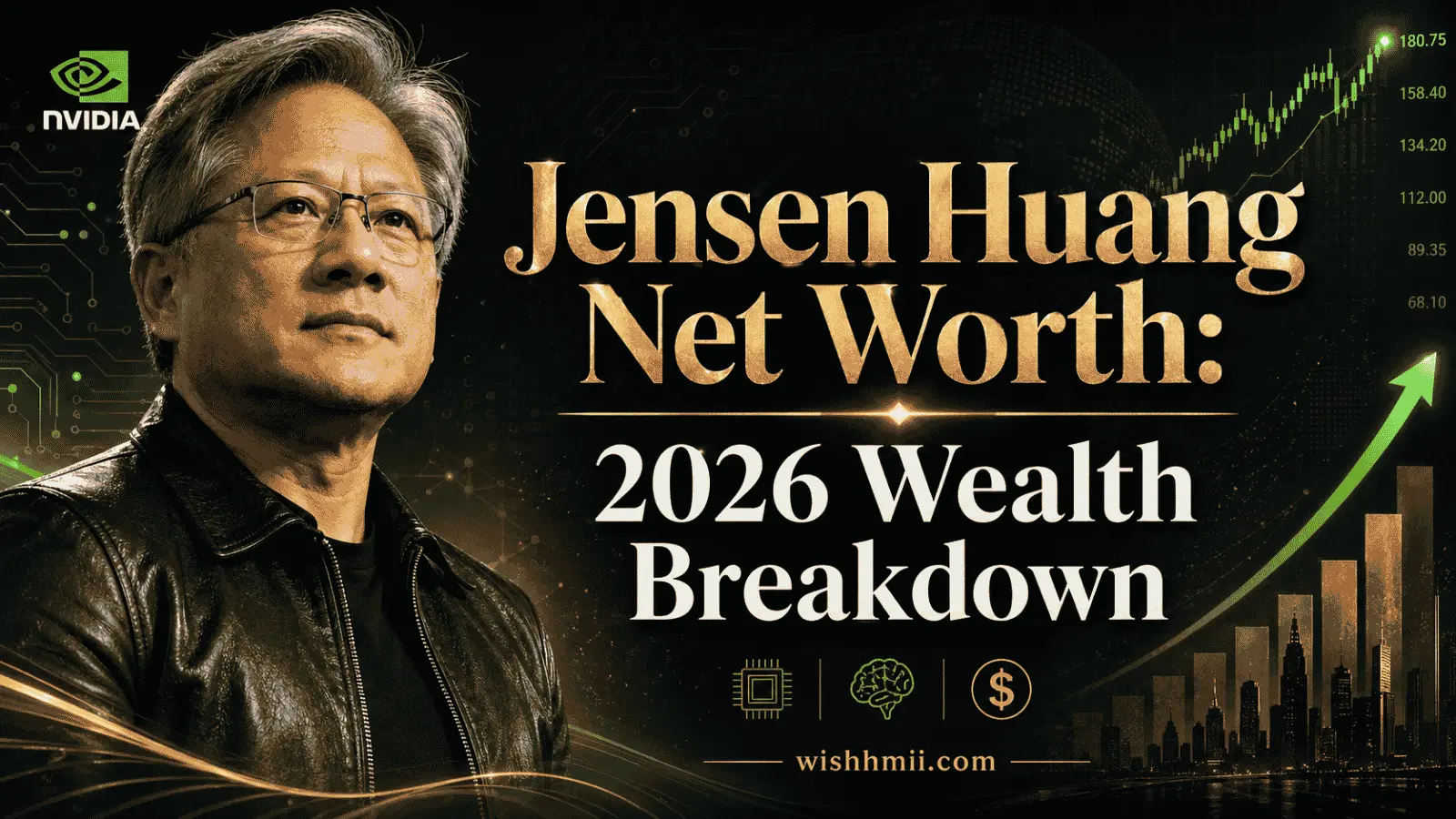
Jensen Huang net worth is estimated at about $184.2 billion by Forbes’ real-time billionaire tracker and about $176 billion by Bloomberg’s Billionaires Index in late April 2026. The exact number changes often because most of his wealth is tied to Nvidia stock, not cash in the bank.
Huang is the co-founder, president, and CEO of Nvidia, the chip company that became central to gaming, data centers, artificial intelligence, robotics, and accelerated computing. His rise is one of the clearest examples of how the AI boom changed global wealth rankings.
This article breaks down his latest estimated net worth, 2025 vs. 2026 wealth change, Nvidia ownership, salary, income sources, career timeline, business roles, public assets, family background, rankings, similar tech billionaire comparisons, and common FAQs. It also explains why Forbes, Bloomberg, and other sources can show different numbers for the same person.
Quick Answer
Jensen Huang is the Taiwanese-born American co-founder and CEO of Nvidia.
His latest estimated net worth is roughly $176 billion to $184.2 billion, depending on whether you use Bloomberg or Forbes. His main wealth source is his ownership stake in Nvidia. Estimates vary because Nvidia’s share price moves daily, and wealth trackers use different methods for taxes, trusts, cash, dividends, and insider-sale assumptions.
Net Worth Snapshot Table
| Category | Details |
|---|---|
| Full name | Jen-Hsun “Jensen” Huang |
| Known as / nickname | Jensen Huang |
| Estimated latest net worth | About $184.2 billion by Forbes; about $176 billion by Bloomberg |
| Estimated 2025 net worth | $98.7 billion on Forbes’ 2025 World’s Billionaires list |
| Change in dollars | About +$85.5 billion using Forbes 2025 vs. Forbes April 2026 real-time figure |
| Change in percentage | About +86.6% using the same Forbes comparison |
| Main wealth source | Nvidia stock ownership |
| Country | United States |
| Industry | Technology / semiconductors / artificial intelligence |
| Age | 63 |
| Birthday | February 17, 1963 |
| Birthplace | Taiwan; major public sources list Taipei or Tainan, so birthplace wording varies by source |
| Nationality | Taiwanese-born American |
| Last updated | April 29, 2026, using Forbes real-time data; Bloomberg data checked April 28, 2026 UTC |
| Confidence level | High for billionaire status and Nvidia-based wealth; medium for exact dollar amount |
| Reason for confidence level | Nvidia is public, Huang’s ownership is disclosed in filings, and Forbes/Bloomberg track him. The exact net worth still changes with stock price and methodology. |
Basic Info
| Field | Details |
|---|---|
| Full name | Jen-Hsun Huang |
| Public name | Jensen Huang |
| Age | 63 |
| Birthday | February 17, 1963 |
| Birthplace | Taiwan |
| Nationality | American; born in Taiwan |
| Profession | Business executive, electrical engineer, company founder |
| Known for | Co-founding Nvidia and leading it through gaming, GPU computing, data centers, and AI |
| Main industry | Semiconductors and artificial intelligence infrastructure |
| Public status | Public company CEO, billionaire, technology leader |
Jensen Huang is best known as the long-serving leader of Nvidia. He co-founded the company in 1993 and has stayed in the CEO role since the beginning. That is unusual in big technology. Many founders step aside after a few years, but Huang remained central to Nvidia’s strategy through gaming GPUs, CUDA, data centers, AI chips, and the company’s rise into one of the world’s most valuable public companies.
Family and Personal Life
Jensen Huang is a public business figure, but he keeps much of his personal life private. Reliable public sources confirm that he is married to Lori Huang, who is also linked to several family trusts and philanthropic giving. Public sources also state that he has children, but their private lives are not central to a net worth profile.
Huang’s parents sent him and his brother to the United States when he was young. Public accounts say the move was connected to instability in Thailand, where the family had lived after leaving Taiwan. He later reunited with his family in Oregon.
| Family detail | Public information |
|---|---|
| Father | Reliable public profiles discuss his parents’ role in sending him to the U.S., but major official business sources do not make his father’s personal details central. |
| Mother | Public details are limited and not needed for wealth analysis. |
| Spouse / partner | Lori Huang |
| Marriage | Publicly known, but the couple keeps personal details low-profile. |
| Children | Public sources say he has children; detailed private information is not included here. |
| Siblings | Public accounts mention a brother; private details are limited. |
| Family background | Born in Taiwan, spent early childhood in Taiwan and Thailand, then moved to the United States. |
| Privacy note | This article avoids private addresses, family details, and personal claims not needed to explain his career or wealth. |
Education
Jensen Huang’s education helped shape his career in semiconductors and computing.
| School / institution | Details |
|---|---|
| High school | Aloha High School in Oregon is widely cited in public profiles. |
| College | Oregon State University |
| Degree | Bachelor’s degree in electrical engineering, earned in 1984 |
| Graduate school | Stanford University |
| Degree | Master’s degree in electrical engineering, earned in 1992 |
| Dropout status | No reliable public source describes him as a college dropout. |
| Academic focus | Electrical engineering |
| Early interests | Technology, computing, video games, and table tennis are commonly discussed in public profiles. |
His engineering background mattered because Nvidia was not built as a media brand or a software app. It was built around hard technical problems: graphics processing, chip architecture, parallel computing, and later AI infrastructure. Huang’s time at Oregon State and Stanford gave him the technical base to work at AMD and LSI Logic before co-founding Nvidia.
Early Life and Background
Jensen Huang was born in Taiwan in 1963. He spent part of his childhood in Taiwan and Thailand before moving to the United States. Public profiles describe a difficult early adjustment. He and his brother were sent to live with relatives in Washington state, and he was later enrolled at a school in Kentucky that was not what his family had expected.
After reuniting with his family in Oregon, Huang attended Aloha High School. He became a strong table tennis player and developed an interest in technology. Public profiles also mention restaurant work earlier in life, which Huang has connected to learning discipline, speed, and comfort with pressure.
His early career began in the semiconductor industry. He worked at AMD from 1984 to 1985 and then at LSI Logic from 1985 to 1993. Those jobs put him close to chip design, computer hardware, and the market problems that later shaped Nvidia.
The turning point came in 1993, when Huang co-founded Nvidia with Chris Malachowsky and Curtis Priem. The company did not become a giant overnight. It had early struggles, changed product direction, and nearly failed before finding its breakthrough in graphics processing.
Career Timeline
| Year | Milestone | What happened | Net worth impact |
|---|---|---|---|
| 1963 | Birth | Huang was born in Taiwan. | No wealth impact. |
| 1970s | Move to the U.S. | He moved to the United States as a child and later settled with family in Oregon. | Built the foundation for his U.S. education and career. |
| 1984 | Oregon State degree | Earned a bachelor’s degree in electrical engineering. | Helped him enter the semiconductor field. |
| 1984–1985 | AMD | Worked at Advanced Micro Devices. | Early chip-industry experience. |
| 1985–1993 | LSI Logic | Held several roles before leaving to start Nvidia. | Gained business and technical experience. |
| 1992 | Stanford master’s degree | Earned a master’s degree in electrical engineering. | Strengthened technical credibility. |
| 1993 | Nvidia founded | Co-founded Nvidia with Chris Malachowsky and Curtis Priem. | Created the asset that became his main wealth source. |
| 1999 | Nvidia IPO and GPU breakthrough | Nvidia went public and introduced the GPU. | Converted founder equity into publicly traded wealth. |
| 2006 | CUDA introduced | Nvidia expanded GPU use beyond graphics into parallel computing. | Helped open the path to AI and data-center growth. |
| 2010s | Data center and AI growth | Nvidia GPUs became more important for machine learning and high-performance computing. | Nvidia stock became the main driver of Huang’s wealth. |
| 2023 | AI boom accelerates | Generative AI demand lifted Nvidia’s revenue, market value, and investor attention. | Huang’s net worth surged with Nvidia stock. |
| 2024 | Nvidia becomes a top global company | Nvidia’s market value passed major milestones as AI spending grew. | Huang entered the very top tier of global billionaires. |
| 2025 | Forbes lists Huang at $98.7 billion | Forbes’ annual list placed him at No. 16 with $98.7 billion. | Established him as one of the richest tech founders. |
| 2025 | DeepSeek selloff | AI-linked stocks fell sharply in January 2025; Nvidia and Huang’s wealth dropped temporarily. | Showed how exposed his wealth is to Nvidia’s share price. |
| 2026 | Nvidia reports fiscal 2026 revenue of $215.9 billion | Nvidia’s AI data-center business kept growing. | Supported higher market value and higher wealth estimates. |
| April 2026 | Forbes and Bloomberg update estimates | Forbes showed about $184.2 billion; Bloomberg showed about $176 billion. | Huang ranked among the world’s 10 richest people. |
Businesses and Ownership
Jensen Huang’s wealth is not spread across many celebrity-style income streams. It is mainly a founder-equity story.
Confirmed Business Roles
| Business / role | Details |
|---|---|
| Nvidia | Co-founder, president, CEO, and board member |
| Nvidia ownership | Forbes says he owns about 3% of Nvidia; Nvidia’s 2025 proxy listed 922,922,938 beneficially owned shares, or 3.77%, as of the proxy filing context |
| Prior employers | AMD and LSI Logic |
| Board role | Nvidia board member since the company’s founding |
| Philanthropy-related entities | The Jen-Hsun & Lori Huang Foundation is listed in Nvidia ownership disclosures as holding Nvidia shares |
Equity Stakes
Huang’s main asset is Nvidia stock. Nvidia’s proxy disclosures show shares held through a mix of personal, trust, investment, and foundation-related entities. Bloomberg’s wealth analysis also notes that part of the stake is held in his own name and family trusts.
That distinction matters. A billionaire may “beneficially own” shares across trusts and entities, but that does not mean all of the value is liquid cash available for personal spending.
Partnerships, Brand Deals, and Business Exits
There is no strong public evidence that Huang’s net worth depends on celebrity-style brand endorsements, sports contracts, touring, streaming, or licensing income. He is wealthy because he co-founded and continues to lead Nvidia.
No major personal “business exit” outside Nvidia is needed to explain his fortune.
Net Worth 2025 vs. Latest Net Worth
| Year / date | Estimated net worth | Dollar change | Percentage change | Main reason |
|---|---|---|---|---|
| Forbes 2025 annual list | $98.7 billion | — | — | Nvidia’s AI-driven rise had already made Huang a top global billionaire. |
| Forbes real-time, April 29, 2026 | $184.2 billion | +$85.5 billion | +86.6% | Nvidia’s stock and market value rose further as AI infrastructure demand stayed strong. |
| Bloomberg, April 28, 2026 UTC | $176 billion | Not directly comparable to Forbes | Not directly comparable to Forbes | Bloomberg uses its own daily index method and showed Huang at No. 7 globally. |
The cleanest year-over-year comparison is Forbes 2025 annual list vs. Forbes real-time April 2026. By that measure, Huang’s estimated wealth rose by about $85.5 billion, or roughly 86.6%.
The main reason is Nvidia’s market value. Huang’s salary is large by normal standards, but tiny compared with the daily swings in his Nvidia stake. A 1% change in Nvidia stock can move his paper wealth by well over $1 billion.
Nvidia’s business also kept expanding. The company reported fiscal 2026 revenue of $215.9 billion, up 65% from the prior year. Its data-center business, powered by AI demand, remained the key growth engine.
Wealth High and Low
Jensen Huang’s public net worth has moved sharply because Nvidia stock has moved sharply.
| Wealth point | Estimate | What caused it |
|---|---|---|
| Highest recent public estimate | About $184.2 billion by Forbes real-time in late April 2026 | Nvidia’s continued AI leadership, strong revenue, and high market value |
| Bloomberg late-April 2026 estimate | About $176 billion | Bloomberg’s daily index method, using market prices and its own cash/liability assumptions |
| Forbes 2025 annual estimate | $98.7 billion | Nvidia had already risen, but the 2026 AI and stock rally had not yet been fully reflected |
| Recent low point discussed publicly | Around $100 billion to $103.7 billion during the January 2025 DeepSeek-related selloff, depending on source | Nvidia shares fell sharply after investors worried about AI chip demand and competition |
Exact high and low figures are hard to lock down because wealth trackers update daily and use different cutoffs. The broad range is clear: Huang moved from roughly the $100 billion area in early 2025 volatility to the $176 billion–$184.2 billion range by late April 2026.
The cause was not a new salary, movie deal, inheritance, or cash payout. It was the market value of Nvidia.
Income Sources
| Income source | Estimated value | Frequency | Reliability | Notes |
|---|---|---|---|---|
| Nvidia stock ownership | Main source; worth well over $170 billion before discounts depending on share count and market price | Changes daily | High | This is the core of Huang’s net worth. |
| Nvidia CEO compensation | $49.87 million total compensation for fiscal 2025 | Annual | High | Includes salary, stock awards, non-equity incentive compensation, and other compensation. |
| Base salary | About $1.49 million in fiscal 2025 | Annual | High | Disclosed in Nvidia’s proxy. |
| Stock awards | About $38.81 million grant-date value in fiscal 2025 | Annual / vesting-based | High | Compensation value is not the same as total net worth. |
| Bonus / incentive pay | $6 million non-equity incentive compensation in fiscal 2025 | Annual | High | Disclosed in proxy table. |
| Dividends | Likely meaningful in absolute dollars because of his share count, but Nvidia’s dividend per share is small | Quarterly | Medium | Nvidia pays a small quarterly dividend. |
| Insider stock sales | Public filings can show sales over time, but they do not define total wealth alone | Occasional | Medium | Wealth trackers may factor sales, taxes, and reinvestment assumptions differently. |
| Private companies | No major private company stake is needed to explain his wealth | Not applicable | Low / not material | Public data points to Nvidia as the main asset. |
| Real estate | No reliable full public portfolio value | Not regular income | Low | Avoid unsupported property claims. |
| Endorsements / sponsorships | No major reliable evidence as a wealth driver | Not material | Low | Huang is a business executive, not an endorsement-based celebrity. |
| Royalties / books / media | No major public evidence as a major income source | Not material | Low | Not central to his fortune. |
| Crypto | No reliable public evidence as a major wealth source | Not material | Low | Do not include in wealth estimate. |
| Speaking fees | Possible, but not publicly central to net worth | Occasional | Low | Not included in the main estimate. |
Property and Assets
Jensen Huang’s confirmed public assets are mostly tied to Nvidia shares, trusts, and investment entities disclosed in corporate filings. Public wealth trackers also estimate cash and other investments based on insider transactions, dividends, taxes, and market performance.
There is no reliable, complete public list of his homes, cars, jets, yachts, land, hotels, or private real estate portfolio. Some online articles make claims about luxury property or lifestyle, but those claims are often thinly sourced and are not needed to explain his net worth.
For that reason, this article does not publish exact addresses or unsupported property values.
| Asset category | Public status |
|---|---|
| Nvidia shares | Strongly documented through SEC filings and wealth trackers |
| Family trusts / related entities | Publicly referenced in Nvidia ownership disclosures |
| Foundation-held Nvidia shares | Publicly referenced in Nvidia proxy disclosures |
| Homes | No complete reliable public portfolio used here |
| Cars | No verified major collection used here |
| Private jet | No reliable public detail used here |
| Yacht | No reliable public detail used here |
| Real estate value | Not included unless supported by strong public records or reputable reporting |
Lifestyle
Jensen Huang is famous for a simple public image: black leather jackets, technology stages, long product presentations, and direct talks with developers, investors, and customers.
His public lifestyle is not built around showing off mansions, yachts, or jewelry. The best-supported lifestyle points are professional rather than luxury-focused:
| Lifestyle area | What is publicly supported |
|---|---|
| Fashion | Known for wearing black leather jackets at major public events |
| Travel | Travels for Nvidia business, product launches, government meetings, and global tech events |
| Cars | No reliable public evidence of a major car collection used here |
| Private jets | Not included due to lack of strong public verification |
| Philanthropy | Public donations include major support for Stanford and Oregon State University |
| Public spending habits | More visible as education and research philanthropy than celebrity luxury spending |
Huang and Lori Huang have been linked to major educational giving. Public sources note a $30 million gift connected to Stanford’s engineering center and a $50 million gift connected to Oregon State University’s namesake research center. These gifts fit Huang’s public identity: engineering, education, and long-term technology development.
Controversies and Legal Issues
Jensen Huang has not been best known for personal scandal. The major controversies around him are mostly tied to Nvidia’s size, export rules, AI chip demand, and public-company litigation.
U.S.–China Export Controls
Nvidia has been affected by U.S. restrictions on advanced AI chip sales to China. In 2025, Nvidia disclosed that new export licensing requirements for certain H20 chips could create large charges tied to inventory and purchase commitments. The issue matters to Huang’s wealth because China access can affect Nvidia revenue expectations, and revenue expectations affect the stock price.
This is a business and policy issue, not a personal legal finding against Huang.
AI Chip Competition and Antitrust Scrutiny
Nvidia’s dominant role in AI chips has attracted regulatory and competition attention. Reports have discussed antitrust scrutiny and questions about whether Nvidia’s market power limits competition. As of this article, the key point for readers is that regulatory risk can affect Nvidia’s stock valuation, which can affect Huang’s estimated net worth.
Securities Litigation Linked to Crypto Revenue
Nvidia and Huang have also faced investor litigation connected to past claims about how much Nvidia’s sales depended on cryptocurrency-related demand. Legal reporting has covered the case at the U.S. Supreme Court level. These matters should be described carefully: allegations are not the same as proven wrongdoing.
Reputation Impact
So far, these issues have not removed Huang from Nvidia leadership or stopped Nvidia from posting record revenue. Still, they are relevant because legal and regulatory uncertainty can move Nvidia’s share price, and that directly changes Huang’s paper wealth.
Ranking
| Ranking category | Latest public context |
|---|---|
| Billionaire status | Yes, billionaire |
| Centibillionaire status | Yes, over $100 billion by major wealth trackers |
| Forbes real-time rank | No. 7 in the world in late April 2026 |
| Forbes 2026 Billionaires list | Forbes profile says No. 8 on its 2026 Billionaires list |
| Bloomberg rank | No. 7 globally on April 28, 2026 UTC |
| U.S. rank | Among the richest people in the United States |
| Industry rank | One of the richest technology and semiconductor executives |
| Richest category | One of the richest founder-CEOs in AI infrastructure |
Huang’s ranking can change daily because he sits near other billionaires whose fortunes are also tied to public stocks, including Michael Dell, Larry Ellison, Mark Zuckerberg, Larry Page, Sergey Brin, Steve Ballmer, and Warren Buffett.
Comparison With Similar People
The table below uses late-April 2026 Bloomberg-style ranking context for broad comparison. Figures can change daily.
| Person | Estimated net worth | Main source of wealth | Industry | Who is richer? | Reason |
|---|---|---|---|---|---|
| Larry Page | About $298 billion | Alphabet / Google | Technology | Larry Page | Larger Alphabet-linked fortune |
| Sergey Brin | About $277 billion | Alphabet / Google | Technology | Sergey Brin | Larger Alphabet-linked fortune |
| Mark Zuckerberg | About $238 billion | Meta | Technology | Mark Zuckerberg | Larger Meta stake value |
| Larry Ellison | About $218 billion | Oracle | Technology | Larry Ellison | Larger Oracle-linked fortune at this date |
| Jensen Huang | About $176 billion to $184.2 billion | Nvidia | Technology / AI chips | — | Main subject |
| Michael Dell | About $174 billion | Dell Technologies / Broadcom-linked holdings | Technology | Huang by Bloomberg; Huang by Forbes | Huang’s Nvidia stake was slightly higher in late April 2026 |
| Steve Ballmer | About $151 billion | Microsoft / investments | Technology | Huang | Nvidia stake valued higher |
| Warren Buffett | About $143 billion | Berkshire Hathaway | Diversified investing | Huang | Nvidia’s AI stock boom pushed Huang above Buffett |
| Bill Gates | About $104 billion | Microsoft / investments | Technology / diversified | Huang | Huang’s concentrated Nvidia stake was higher |
Why Net Worth Estimates Differ
Net worth is an estimate, not a bank balance. Jensen Huang is a perfect example because most of his fortune is tied to one public stock.
Here is why different sources show different numbers:
- Nvidia shares change price daily.
A small percentage move in Nvidia stock can change Huang’s fortune by billions. - Trackers use different share counts.
Forbes and Bloomberg may treat trusts, foundations, unvested stock, and related entities differently. - Taxes are estimates.
Wealth trackers may estimate tax effects from stock sales, but exact personal tax details are private. - Cash is hard to know.
A billionaire’s cash balance is not fully public. - Debt is not always public.
Personal loans, pledges, or liabilities may not be visible. - Some assets are illiquid.
Even when shares are public, selling a large stake can be complicated. - Different cutoff times matter.
Forbes may update during or after market activity, while Bloomberg updates after the close of trading in New York. - Net worth is not cash in the bank.
Huang is rich mostly because he owns Nvidia shares. That value can rise or fall before any shares are sold.
How We Estimated Net Worth
This article uses a source-weighted estimate rather than pretending to know Huang’s exact personal finances.
The method is:
| Component | How it was treated |
|---|---|
| Public company shares | Nvidia share ownership from SEC filings and wealth trackers is the main base. |
| Market value | Nvidia’s current market value and share price explain most of the change. |
| Forbes estimate | Used for the highest latest public figure and the 2025 annual comparison. |
| Bloomberg estimate | Used to cross-check ranking, daily movement, and methodology. |
| Salary and compensation | Included separately because it is small compared with equity wealth. |
| Real estate | Not included as a major number because reliable public portfolio data is limited. |
| Private investments | Not treated as a major source unless supported by reliable public evidence. |
| Dividends and cash | Acknowledged, but not overestimated. |
| Taxes and liabilities | Mentioned as reasons estimates differ; exact private values are unknown. |
Best estimate range: $176 billion to $184.2 billion in late April 2026.
A practical midpoint estimate would be around $180 billion, but the exact figure can change quickly with Nvidia’s share price.
Latest Updates
| Update type | Latest available information |
|---|---|
| Most recent wealth change | Forbes showed Huang at about $184.2 billion in late April 2026; Bloomberg showed about $176 billion on April 28, 2026 UTC. |
| Most recent business update | Nvidia reported fiscal 2026 revenue of $215.9 billion, up 65% year over year. |
| Most recent ranking update | Bloomberg ranked Huang No. 7 globally on April 28, 2026 UTC. Forbes’ profile showed him No. 7 in real time and No. 8 on its 2026 Billionaires list. |
| Most recent career update | Huang remains Nvidia’s co-founder, president, CEO, and board member. |
| Date of latest available information | Late April 2026. |
FAQ
What is Jensen Huang’s net worth?
Jensen Huang’s net worth is estimated at about $176 billion to $184.2 billion in late April 2026. Bloomberg showed about $176 billion, while Forbes showed about $184.2 billion.
How did Jensen Huang get rich?
He got rich mainly by co-founding Nvidia and keeping a large ownership stake as the company grew. Nvidia’s rise in gaming, data centers, GPUs, and AI chips made his shares extremely valuable.
What is Jensen Huang’s salary?
Nvidia’s 2025 proxy listed Huang’s fiscal 2025 base salary at about $1.49 million. His total reported compensation for fiscal 2025 was about $49.87 million, mostly from stock awards and incentive pay.
How much does Jensen Huang make per year?
His annual reported compensation was about $49.87 million for fiscal 2025. But his net worth can rise or fall by billions in a year because of Nvidia stock movement.
Is Jensen Huang a billionaire?
Yes. Jensen Huang is a billionaire and a centibillionaire, meaning major wealth trackers estimate his fortune at more than $100 billion.
What businesses does Jensen Huang own?
His main business interest is Nvidia. He co-founded the company in 1993 and remains its president, CEO, and board member. Public data does not show another private business that explains his wealth better than Nvidia.
What is Jensen Huang’s biggest income source?
His biggest wealth source is Nvidia stock. Salary, bonus, and other compensation are much smaller than the value of his equity stake.
How much was Jensen Huang worth in 2025?
Forbes listed Jensen Huang at $98.7 billion on its 2025 World’s Billionaires list. His wealth later moved much higher as Nvidia’s market value rose.
Why do Jensen Huang net worth estimates differ?
They differ because Nvidia stock changes daily, and trackers use different methods for share ownership, trusts, taxes, cash, liabilities, and timing.
Who is richer, Jensen Huang or Michael Dell?
In late April 2026, Huang was slightly richer by Bloomberg’s ranking, with about $176 billion compared with Michael Dell at about $174 billion. The gap can change quickly because both fortunes depend heavily on public market values.
Does Jensen Huang own real estate?
He likely owns personal property, but there is no complete reliable public real estate portfolio that should be used to calculate his fortune. This article does not include exact addresses or unsupported property claims.
What is Jensen Huang’s latest ranking?
Bloomberg ranked Huang No. 7 globally on April 28, 2026 UTC. Forbes’ profile showed him No. 7 in real time in late April 2026 and No. 8 on its 2026 Billionaires list.
Conclusion
Jensen Huang net worth is best understood as a Nvidia stock story. In late April 2026, Forbes estimated his fortune at about $184.2 billion, while Bloomberg estimated it at about $176 billion. The difference does not mean one source is “lying”; it means billionaire wealth tracking depends on market prices, ownership assumptions, taxes, cash estimates, and timing.
His fortune rose sharply from Forbes’ $98.7 billion 2025 estimate because Nvidia became even more valuable during the AI infrastructure boom. Huang’s salary is large, but his real wealth comes from founder equity. As long as Nvidia remains central to AI computing, his net worth will keep moving with the stock market.
Source Notes
| Source name | Page title | What it was used for | Link |
|---|---|---|---|
| Forbes | Jensen Huang profile | Latest Forbes real-time net worth, Forbes rank, 2026 list context, ownership summary, 2025 comparison context | |
| Bloomberg | Bloomberg Billionaires Index: Jensen Huang | Bloomberg net worth, rank, daily movement, Nvidia ownership explanation, methodology, education, biography, milestones | |
| U.S. SEC / Nvidia proxy | Nvidia 2025 DEF 14A proxy statement | Beneficial ownership, share count, CEO compensation, trusts, foundation-held shares, compensation table | |
| Nvidia Investor Relations | Fiscal 2026 fourth-quarter and full-year results | Nvidia fiscal 2026 revenue, Q4 revenue, AI/data-center business context | |
| Nvidia official bio | Jensen Huang, Nvidia board / management bio | Founder role, CEO role, board role, AMD and LSI Logic career history | |
| Stanford Engineering | Jensen Huang profile | Stanford education, GPU impact, philanthropy context | |
| Stanford / Business Wire | Jen-Hsun Huang $30 million Stanford gift | Philanthropy and engineering-center donation context | |
| Britannica Money | Jensen Huang biography | Early life, education, spouse context, Oregon background | |
| Business Insider | Jensen Huang profile and DeepSeek selloff coverage | Public profile context, Nvidia family-business reporting, January 2025 wealth volatility | |
| TechCrunch | Nvidia H20 export-license report | U.S.–China export-control context affecting Nvidia | |
| AP News | China summons Nvidia over H20 chip concerns | China regulatory concern and Nvidia denial context | |
| Supreme Court filing / legal reporting | Nvidia securities litigation materials | Securities lawsuit context involving Nvidia and Huang |