
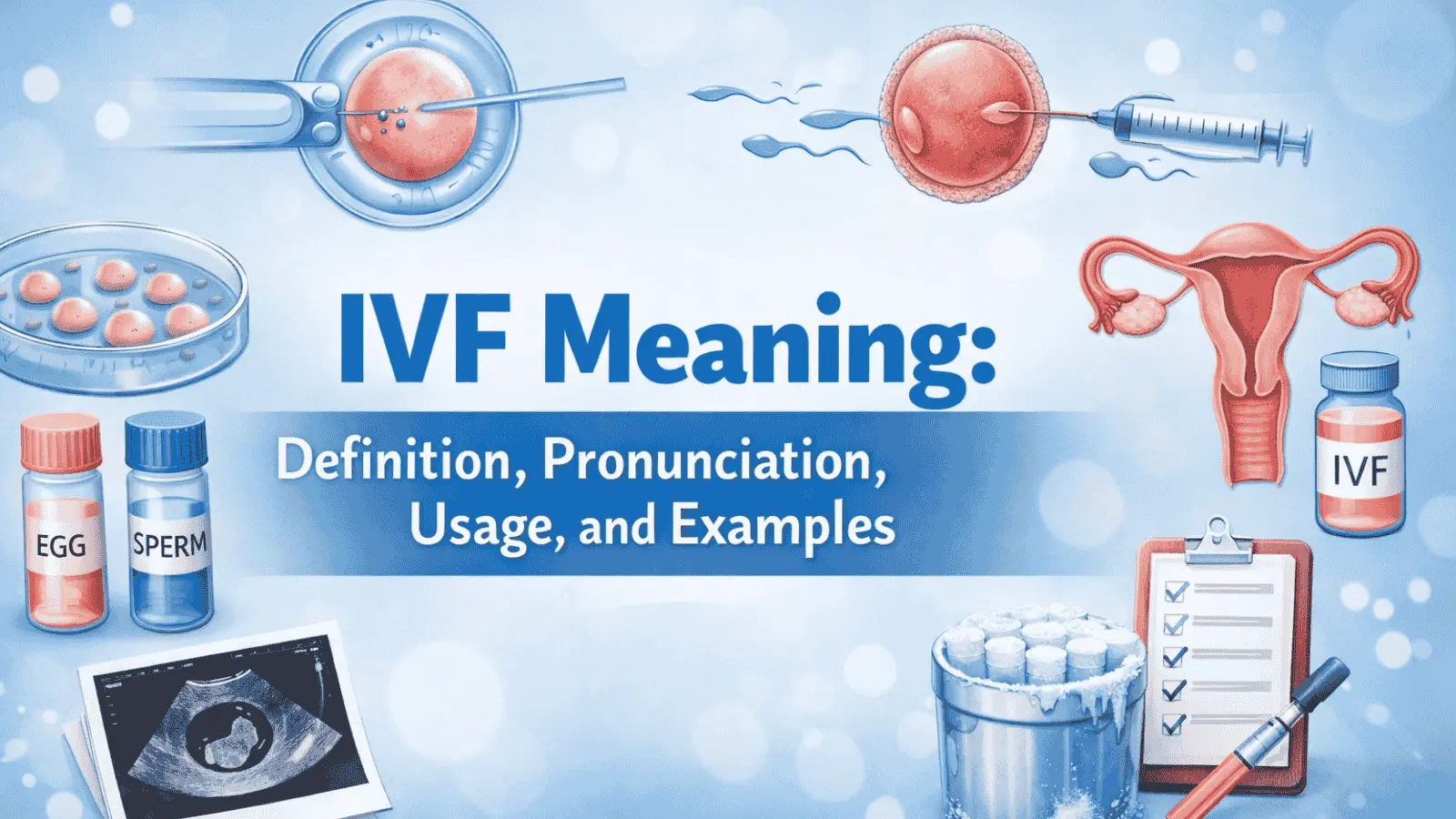
You may see IVF in health articles, clinic websites, news stories, or everyday conversation. Many people know it relates to pregnancy, but they may not know what the letters mean.
That is why this term matters. It is common in modern English, especially in medical and family-planning contexts. If you understand the term, related articles and conversations become much easier to follow.
This guide explains the IVF meaning in plain English. You will learn what it stands for, how to say it, how people use it in sentences, and which similar terms people often confuse with it.
Quick Answer
IVF meaning is in vitro fertilization. It is a medical treatment in which an egg and sperm are joined outside the body, and the resulting embryo is later placed in the uterus.
TL;DR
• IVF stands for in vitro fertilization.
• It is a medical abbreviation.
• People say the letters: I-V-F.
• It is used like a noun.
• It is not slang.
• It is different from IUI.
What IVF Means in Plain English
In plain English, IVF means a way to help someone get pregnant.
Instead of fertilization happening inside the body, it happens in a lab. After that, an embryo may be placed in the uterus.
A simple way to say it is this: doctors help the egg and sperm meet outside the body.
What Does IVF Stand For?
IVF stands for in vitro fertilization.
The word fertilization means an egg is joined with sperm. The phrase in vitro is Latin and is commonly understood to mean something done outside a living body, usually in a lab setting.
In American English, you will usually see fertilization with a z. In British English, you may see fertilisation with an s.
Is IVF a Word, an Abbreviation, or a Medical Term?
IVF is best understood as an abbreviation or initialism for in vitro fertilization.
It is also a medical term. People use it in healthcare, news, and normal conversation.
It is not slang. It is also not a casual nickname. It is a standard medical term that many people know.
How to Pronounce IVF
Most people pronounce IVF by saying each letter:
I-V-F
Simple guide: eye-vee-eff
People do not usually say it as one word. They say the letters one by one.
Common mistake: saying the full phrase every time
Correction: In normal conversation, many people simply say “IVF.”
Part of Speech: How IVF Functions in a Sentence
IVF is usually used as a noun.
More specifically, it often acts like an uncountable noun when people mean the treatment in general.
Examples:
• “They are considering IVF.”
• “IVF can be emotionally demanding.”
• “She learned more about IVF at her appointment.”
Sometimes people use it in a countable way in casual speech, especially when talking about treatment attempts.
Example:
• “They went through two IVF cycles.”
That does not mean IVF becomes a different part of speech. It is still functioning as a noun.
How IVF Works in Basic Terms
The full medical process can be complex. Still, the basic idea is simple.
Doctors collect eggs and combine them with sperm outside the body. If fertilization happens, an embryo can develop. A doctor may then place an embryo into the uterus.
You do not need every medical detail to understand the meaning. The key point is this: IVF is a fertility treatment where fertilization happens outside the body.
When People Use the Term IVF
People use the term IVF when talking about fertility treatment.
You may hear it in these contexts:
• doctor visits
• health articles
• family-planning discussions
• personal stories
• news about reproductive care
People may mention IVF when pregnancy has been hard to achieve naturally. The term may also appear in discussions about fertility preservation or genetic testing.
When Not to Use IVF
Do not use IVF as if it means pregnancy itself. IVF is a treatment, not the pregnancy.
Do not use it as a slang term. That can confuse readers.
Also, do not use IVF as a general word for all fertility care. It is one specific treatment, not every treatment.
Common Contexts and Real Examples
Here are a few natural examples:
• “They started IVF after other treatments did not work.”
• “Her doctor explained the IVF process clearly.”
• “The article discussed access to IVF care.”
• “We learned that IVF stands for in vitro fertilization.”
• “He asked how IVF is pronounced.”
Notice that IVF often appears in health or family contexts. It can sound personal, serious, and medical.
Related Terms People Mix Up With IVF
Several related terms can cause confusion.
IUI is not the same as IVF. In IUI, sperm is placed inside the uterus. In IVF, fertilization happens outside the body first.
ART means assisted reproductive technology. That is a broader category. IVF is one kind of treatment within that group.
Test-tube baby is an older popular phrase. Many people now avoid it because it can sound outdated or oversimplified.
| Context | Best Choice | Why |
|---|---|---|
| You mean the specific treatment | IVF | It names the treatment directly |
| You mean a broader field | ART | It covers more than one treatment |
| You mean a different fertility method | IUI | It is not the same process |
Synonyms and Antonyms
There is no perfect everyday synonym for IVF.
The closest match is the full term:
• in vitro fertilization — the full form of IVF
Some related phrases may appear nearby, but they are not exact synonyms:
• fertility treatment
• assisted reproduction
• assisted reproductive technology
There is no true antonym that fits cleanly. A phrase like natural conception describes a different situation, but it is not a direct opposite in the dictionary sense.
Common Mistakes
One common mistake is thinking IVF means “pregnant through medicine.” That is too broad.
Another mistake is calling any fertility treatment IVF. Some treatments are different.
A third mistake is using IVF as slang. It is better to treat it as a medical term.
Here are quick fixes:
• Wrong: “IVF means pregnancy treatment in general.”
• Better: “IVF is one specific fertility treatment.”
• Wrong: “IVF and IUI are the same.”
• Better: “IVF and IUI are different treatments.”
• Wrong: “IVF is slang.”
• Better: “IVF is a standard medical abbreviation.”
Mini Quiz
1. What does IVF stand for?
2. Is IVF usually pronounced as one word or letter by letter?
3. Is IVF slang or a medical term?
4. Does IVF mean all fertility treatment?
5. Is IVF the same as IUI?
Answer key:
- In vitro fertilization
- Letter by letter
- A medical term
- No
- No
FAQ
What does IVF stand for?
IVF stands for in vitro fertilization. It names a fertility treatment where fertilization happens outside the body.
What is IVF in simple words?
In simple words, IVF is a medical way to help someone get pregnant. Doctors join an egg and sperm in a lab, then may place an embryo in the uterus.
Is IVF a word or an abbreviation?
IVF is an abbreviation, and more specifically an initialism. People usually say the letters separately.
How do you pronounce IVF?
Most people say I-V-F. A simple pronunciation guide is eye-vee-eff.
What is IVF used for?
IVF is used in fertility care. It may help people who are having trouble getting pregnant through other methods.
What does “in vitro” mean in IVF?
“In vitro” is a Latin phrase. In this context, it refers to something done outside the body, usually in a lab.
Is IVF the same as IUI?
No. They are different fertility treatments. IVF involves fertilization outside the body, while IUI does not.
Conclusion
Now you know the IVF meaning in clear, simple terms.
It stands for in vitro fertilization and refers to a specific fertility treatment. The next helpful step is to remember both the full form and the basic idea behind it.