
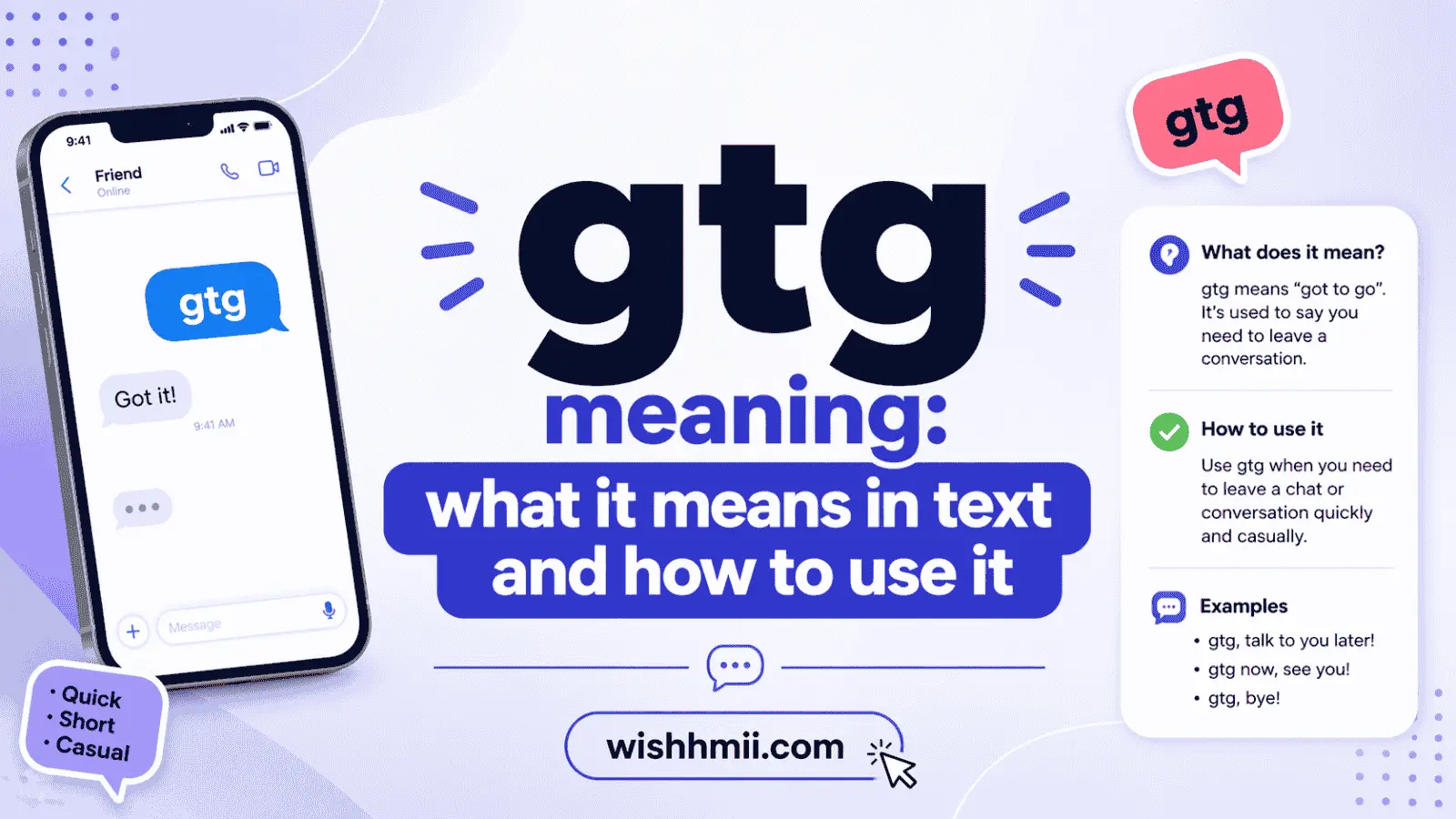
You may see gtg in a text, group chat, game chat, or social post. It is short, quick, and easy to miss if English is not your first language.
That is why it helps to know what it means and how people use it. A small phrase like this can change the tone of a message.
In most cases, gtg tells someone that the writer is leaving the conversation. It is common in casual digital English.
This guide explains the plain meaning, how it works in messages, when it sounds natural, and when it may sound too casual. You will also see examples, a quick comparison with similar chat terms, and a short quiz to test yourself.
Quick Answer
gtg meaning usually means “got to go.”
People use it in casual messages to say they need to leave, log off, or end a chat.
Less often, it can also mean “good to go,” so context matters.
TL;DR
• gtg usually means got to go.
• It is common in casual texting.
• It often signals a quick goodbye.
• It can also mean good to go.
• It is usually too casual for work.
• Context tells you which meaning fits.
What Does GTG Mean?
GTG is a short written form used in digital communication. In most cases, it stands for “got to go.”
People use it when they need to leave a conversation. It can mean they are busy, logging off, or simply ending the chat.
In plain English, it often means:
• I have to leave now.
• I need to go.
• I am ending this chat.
A natural example is:
“Dinner’s ready. gtg!”
What GTG Means in Text and Online Chat
In texts and chats, gtg is usually a fast sign-off. It tells the other person that the conversation is ending.
It does not always mean the person is going somewhere physically. Sometimes it just means they are done texting for now.
You may see it in places like:
• text messages
• group chats
• gaming chats
• social apps
• casual email threads between friends
Example:
“Sorry, my class is starting. gtg.”
A common mistake is using it with no context in a serious conversation.
Better: “I need to join a meeting. gtg, talk later.”
Can GTG Also Mean “Good to Go”?
Yes. In some contexts, gtg can mean “good to go.” That means ready, prepared, or cleared to start.
Example:
“Mic check done. We’re gtg.”
This use is real, but it is less common than “got to go.” Because the two meanings are very different, readers usually rely on context.
Compare these:
• “Phone dying, gtg.” = got to go
• “The file is approved. gtg.” = good to go
If the meaning could confuse someone, write the full phrase instead.
Part of Speech and How GTG Functions
GTG is usually an abbreviation used as a short message or set phrase. It is not normally used like a regular verb or noun in full formal writing.
Most often, it works like a fixed phrase in chat. It can stand alone or appear at the end of a sentence.
Examples:
• “gtg”
• “I’m tired, gtg.”
• “We’re gtg for 3 PM.”
In another rare use, some people write gtg as a short form for get-together. That is much less common in everyday chat. Most readers will first think of got to go.
So for most learners, the safest label is this:
GTG is a casual internet abbreviation used as a phrase in messages.
How to Pronounce GTG
Most people say GTG in one of two ways when speaking aloud:
• “gee-tee-gee”
• “gotta go”
Both are understandable in casual speech. The second one sounds more natural in fast conversation.
Simple guide:
gee-tee-gee = letter by letter
gotta go = said like the full idea
If you are unsure, saying “gotta go” is often the clearest choice in speech.
When to Use GTG
Use gtg when the setting is casual and the message is short. It works best when speed matters.
Good times to use it:
• texting friends
• ending a quick chat
• leaving a game or voice chat
• replying fast before going offline
Examples:
• “Mom’s here, gtg.”
• “It’s late. gtg, night!”
• “Bus is here, gtg.”
It can sound friendly if you add a soft ending.
Example: “gtg, talk later!”
When Not to Use GTG
Do not use gtg when the tone needs to be formal, careful, or respectful. It can sound too brief in professional or serious settings.
Avoid it in:
• job emails
• messages to clients
• school writing
• formal requests
• serious personal talks
Less natural:
“Dear Professor, gtg so I can’t attend.”
Better:
“I need to leave now, so I won’t be able to attend.”
If you want to sound polite, write the full message instead of the abbreviation.
GTG vs BRB vs TTYL
These three are easy to mix up. They are similar, but they do not mean the same thing.
| Context | Best Choice | Why |
|---|---|---|
| You are leaving now | GTG | It means you need to go |
| You will return soon | BRB | It means be right back |
| You are ending for now, but may chat later | TTYL | It means talk to you later |
Quick examples:
• “Doorbell. brb.”
• “Need to head out. gtg.”
• “Busy now. ttyl.”
A common mistake is using brb when you are not coming back soon. Use gtg instead.
Examples of GTG in Real Messages
Seeing real examples makes the meaning easier to remember. Here are some natural ways people use it.
Casual texting:
• “Can’t talk now, gtg.”
• “Dad’s waiting outside. gtg.”
Group chat:
• “Great catching up, everyone. gtg.”
• “I have homework. gtg, bye!”
Gaming:
• “One more round? Sorry, gtg.”
• “Lag is bad and I need dinner. gtg.”
Ready/start meaning:
• “Camera is on and slides are loaded. gtg.”
• “Everything checks out. We’re gtg.”
Notice how the second meaning needs stronger context.
Related Terms, Synonyms, and Antonyms
A few terms are close to gtg, but they are not always exact matches.
Close synonyms in casual chat:
• bye — simple and common
• gotta run — very close in tone
• talk later — softer ending
• signing off — more deliberate
Near alternatives, not exact matches:
• brb — leaving briefly, then returning
• ttyl — not leaving this second, but ending for now
• afk — away from keyboard, often temporary
True antonyms are weak here because gtg is a chat signal, not a standard adjective. The nearest opposite ideas are:
• I’m back
• here now
• ready to chat
So it is better to think in opposite situations, not strict antonyms.
Common Mistakes With GTG
One mistake is assuming gtg always means only one thing. It usually means got to go, but context can change it.
Another mistake is using it in formal writing. That often sounds too abrupt.
Here are quick fixes:
• Wrong: “We are gtg now” when you mean leaving a chat in a report
Correct: “We need to leave now.”
• Wrong: “gtg” to a manager in a serious thread
Correct: “I have to step away now.”
• Wrong: reading “We’re gtg” as “we’re leaving”
Correct: in that sentence, it may mean “good to go”
Uppercase and lowercase both appear. GTG and gtg are both normal in casual messages.
FAQ
What does GTG mean in text?
In text, gtg usually means “got to go.” It tells the other person you need to leave or stop chatting. It is common in casual messages.
What does GTG stand for?
Most often, it stands for “got to go.” In some situations, it can also stand for “good to go.”
Can GTG mean good to go?
Yes. That meaning is valid. It is less common, so the sentence needs clear context.
Is GTG rude in a text?
Not usually. It can sound fine with friends, but it may feel abrupt if the topic is serious. Adding a short friendly phrase helps.
Can I use GTG in work messages?
Usually, it is better not to. In work settings, full phrases sound clearer and more polite.
What is the difference between GTG and BRB?
GTG means you are leaving. BRB means you will be back soon. That is the key difference.
How do you pronounce GTG?
People often say “gee-tee-gee” or “gotta go.” Both are easy to understand in casual speech.
Mini Quiz
- In “Dinner’s ready, gtg,” what does gtg mean?
- Which is better if you will return in five minutes: gtg or brb?
- Is gtg a good choice in a formal email?
- In “We’ve tested everything. We’re gtg,” what does gtg mean?
Answer key:
- got to go
- brb
- No
- good to go
Conclusion
Now you know the gtg meaning in the way people actually use it.
Most of the time, it means got to go in a casual message. Less often, it means good to go, so always check the context.
Once you notice that pattern, gtg becomes easy to read and use with confidence.