
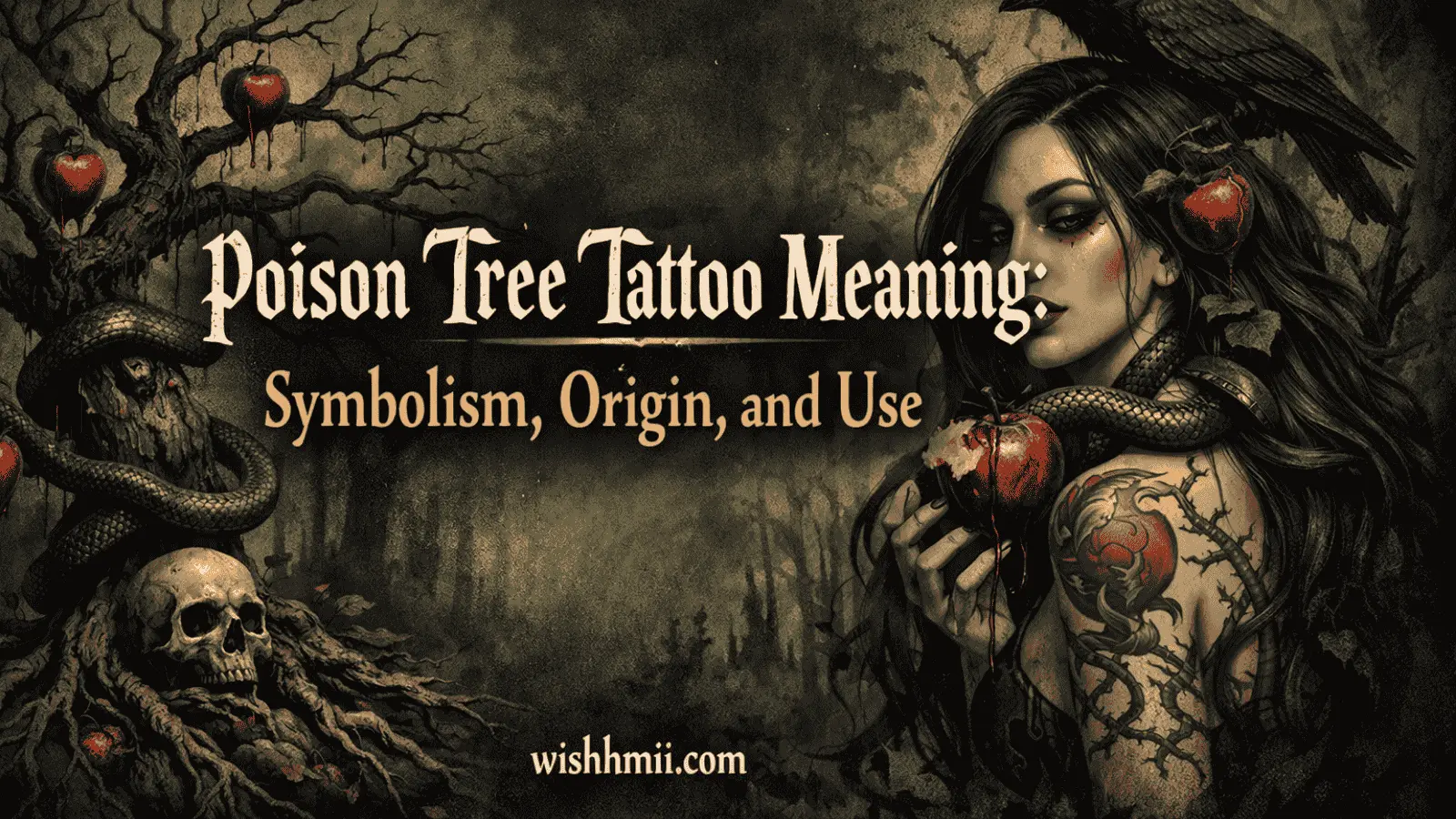
People often search this phrase after seeing a tattoo, a caption, or a design idea online. In most cases, they want to know what the image stands for, not just what it looks like. Today, this tattoo is usually read as a symbol of hidden anger, emotional pain, warning, or personal growth.
The strongest public source behind the phrase is William Blake’s poem A Poison Tree. That poem links silence, anger, and harmful results, so many tattoo readers connect the design with resentment that grows when it stays hidden. This article explains the meaning in plain English, where it likely comes from, how people use it, and what to avoid when describing it.
Quick Answer
Poison tree tattoo meaning usually points to hidden anger, resentment, betrayal, or emotional pain that grows over time. It can also mean self-awareness, healing, or a warning not to let toxic feelings take root.
TL;DR
• Usually tied to hidden anger or resentment.
• Often linked to William Blake’s poem.
• Can also suggest warning and self-protection.
• Some people use it for healing and growth.
• It is symbolic, not a fixed dictionary term.
• Meaning depends on design and personal context.
What Does “Poison Tree Tattoo” Mean?
In plain English, a poison tree tattoo usually means a harmful feeling that has grown over time. That feeling is often anger, bitterness, betrayal, or emotional hurt.
The phrase can also suggest that something beautiful may hide danger. A bright apple, dark branches, or twisted roots may show how pain can look attractive, secret, or powerful from the outside.
Definition in Plain English
A poison tree tattoo is a symbolic tattoo design, usually based on the idea that unspoken anger can grow into something destructive. In modern tattoo talk, people also use it for caution, emotional boundaries, and surviving hard experiences.
This is not a formal dictionary entry with one exact definition. It is a meaning-based phrase, so the design may carry a darker message for one person and a healing message for another.
Where the Meaning Comes From
The clearest source is William Blake’s poem A Poison Tree, first published in 1794 as part of Songs of Experience. In the poem, the speaker says anger ended when it was spoken to a friend, but grew when it stayed hidden from a foe.
That idea made the image powerful for tattoo culture. A tree becomes a picture of emotion growing in secret, and the apple suggests the final result of that buried anger. That is why many modern explanations connect this tattoo to resentment, revenge, secrecy, and emotional honesty.
What It Can Symbolize in a Tattoo
The most common reading is suppressed anger. Someone may choose this design to show what happens when pain is not addressed.
Another common reading is betrayal or toxic relationships. In that use, the tattoo marks a painful lesson about trust, manipulation, or emotional harm.
It can also mean healing and self-awareness. Some people use the tattoo as proof that they faced those feelings and moved past them.
A smaller group read it as warning and protection. In that sense, the tree says, “I know what can hurt me now.”
Part of Speech and Phrase Type
Poison tree tattoo is best understood as a noun phrase. It names a type of tattoo design or tattoo concept.
In a sentence, you would usually use it like this: “Her poison tree tattoo has a bright apple” or “He chose a poison tree tattoo after reading Blake.” It is not a verb, adjective, or slang word on its own.
Common Contexts Where People Use It
You will often see this phrase in tattoo galleries, social posts, design captions, and symbol explainer articles. People also use it in conversations about literary tattoos because of the Blake connection.
It can appear in personal storytelling too. Someone might say the tattoo represents a hard period, a lesson about silence, or a move from bitterness to healing.
When to Use This Phrase and When Not to Use It
Use the phrase when you are talking about the tattoo design, its symbolism, or its literary origin. It works well in plain descriptions, tattoo consultations, and caption writing.
Do not treat it like a fixed universal symbol with one official meaning. Also, do not assume every tree tattoo with dark branches is a poison tree tattoo. The wearer’s intent, the design details, and the Blake reference all matter.
Related Terms and Common Confusions
A poison tree tattoo is not the same as a poison ivy tattoo. Poison ivy usually points more to the plant itself, while poison tree usually carries a broader symbolic or literary meaning.
It is also different from a tree of life tattoo, which usually suggests life, family, growth, or connection. The poison tree idea is darker and more cautionary.
Another confusion is spelling. People often type tatto meaning when they mean tattoo meaning. In standard English, tattoo is the correct spelling.
Synonyms and Antonyms
There is no perfect one-word synonym for poison tree tattoo. Close idea matches include resentment tattoo, warning tattoo, betrayal symbol, or healing-after-pain tattoo, depending on context.
There is no exact antonym either. A loose opposite in tattoo symbolism might be a tree of life tattoo or another design that stands for peace, openness, or renewal.
Quick Comparison Table
| Context | Best Choice | Why |
|---|---|---|
| Literary reference | poison tree tattoo | Best when Blake’s poem is the source |
| Emotional warning | poison tree tattoo | Fits secrecy, anger, and harm |
| Personal recovery | poison tree tattoo | Can show healing after pain |
| Family, roots, life | tree of life tattoo | More positive and less cautionary |
| Plant-specific design | poison ivy tattoo | Better for the actual plant image |
Examples in Real Sentences
“Her poison tree tattoo represents anger she kept hidden for years.”
“He chose a poison tree tattoo after studying William Blake in college.”
“For him, the poison tree tattoo is not about revenge now. It is about healing.”
“Before you describe it online, ask whether the wearer means warning, pain, or growth.”
Common Mistakes
One mistake is saying it always means revenge. That can be true, but many people use it for healing, boundaries, or emotional awareness too.
Another mistake is ignoring the poem behind it. Even when the wearer is not quoting Blake directly, public explanations still most often trace the symbol back to A Poison Tree.
A final mistake is using the typo tatto in formal writing. The standard form is tattoo.
FAQ
What does a poison tree tattoo symbolize?
It usually symbolizes hidden anger, resentment, betrayal, or emotional pain. In some cases, it also stands for healing, awareness, and stronger boundaries.
Is a poison tree tattoo based on William Blake’s poem?
Very often, yes. Public explanations repeatedly connect the tattoo to Blake’s 1794 poem A Poison Tree, where anger grows when it stays unspoken.
Does a poison tree tattoo always mean anger?
No. Anger is the strongest reading, but many people use the design to show survival, recovery, caution, or self-protection.
Can a poison tree tattoo have a positive meaning?
Yes. Some people choose it as a sign that they faced painful emotions and grew from them. In that case, the tattoo can point to healing and self-knowledge.
Is poison tree tattoo a slang term?
No. It is better understood as a symbolic tattoo phrase or design label, not everyday slang.
Why do people get poison tree tattoos?
People often choose it for personal reasons. The design can help them mark betrayal, emotional struggle, a literary connection, or a reminder not to let pain grow in silence.
Mini Quiz
- Is “poison tree tattoo” a fixed dictionary term?
- What poem is most often linked to the phrase?
- Can the tattoo mean healing, or only anger?
- Is “tatto” the standard spelling?
Answer Key
- No. It is a symbolic phrase.
- A Poison Tree by William Blake.
- Yes, it can also mean healing.
- No. The correct spelling is tattoo.
Conclusion
Poison tree tattoo meaning usually centers on hidden anger, warning, and emotional growth. The clearest origin comes from Blake’s poem, but the final meaning still depends on the wearer and the design.