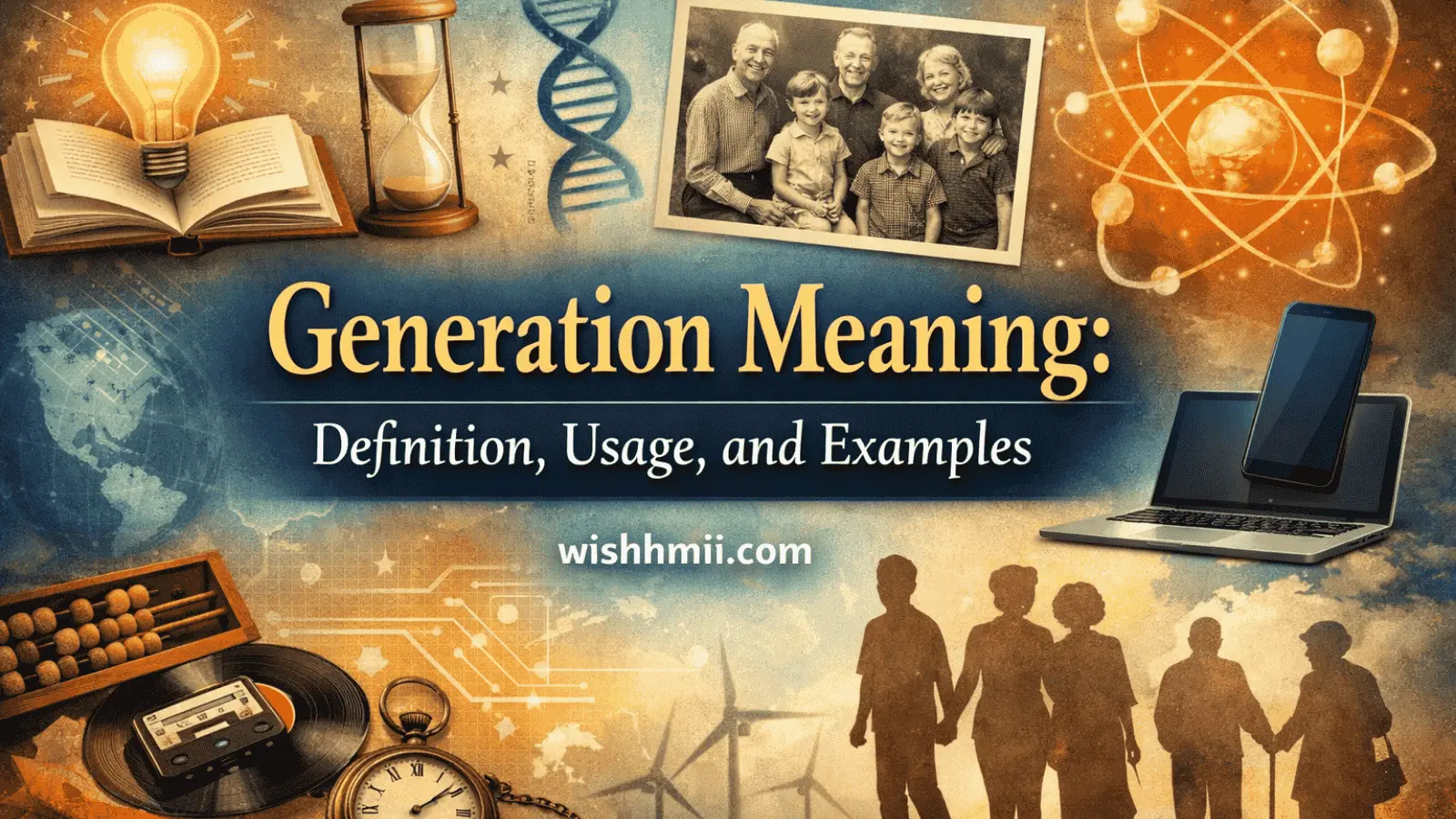
You may see the word generation in family talk, news stories, school lessons, and product ads. People use it when they talk about parents and children, groups like Gen Z, or newer versions of phones and other devices.
That mix can make the word feel confusing. The same word works in more than one common setting.
This guide explains the plain meaning of generation, how Americans often use it, how to pronounce it, and how to choose the right meaning from context. You will also see simple examples, common mistakes, and short answers to frequent questions.
Quick Answer
Generation meaning depends on context. Most often, generation means a group of people born around the same time, one step in a family line, or a newer version of a product or system.
TL;DR
• Generation is usually a noun.
• It often means an age group.
• It can mean a family level.
• It can mean a newer product version.
• It is not slang by itself.
• Context tells you the right meaning.
What Does “Generation” Mean?
In plain English, generation means a group connected by time or by a stage in a sequence.
For people, it often means those born around the same time. In families, it means one level in the family line. In products, it means one version that comes before or after another.
So the word stays the same, but the setting changes the meaning.
Part of Speech: Is “Generation” a Noun?
Yes. Generation is a noun.
It is usually a countable noun. That means you can say a generation, one generation, or three generations.
Examples:
• My grandparents are from a different generation.
• Three generations lived in that house.
• This is the latest generation of the device.
You will also see the adjective generational. Example: There is a generational difference in music taste.
Common Meanings by Context
The word generation has three main everyday uses in American English.
• A family level, such as parents, children, or grandparents
• A social age group, such as Millennials or Gen Z
• A version of a product, machine, or system
A reader usually understands the meaning from the sentence around it.
| Context | Best Choice | Why |
|---|---|---|
| Family tree | generation | Shows one level in a family line |
| Age group in society | generation | Means people from a similar time |
| Phone or car version | generation | Means a newer or older model |
What “Generation” Means in Family Talk
In family talk, a generation is one step in the line from parent to child.
Your grandparents are one generation. Your parents are the next. You are another.
Examples:
• My family has lived here for four generations.
• She is the first in her generation to go to college.
• Three generations came to the reunion.
A common mistake is to use generation when you mean only age. In family talk, the focus is the family line, not just how old someone is.
What “Generation” Means in Social Groups
In society, a generation often means people born in about the same period who share major events, trends, or habits.
This is how people talk about Baby Boomers, Gen X, Millennials, or Gen Z. Here, the word is about a broad age group, not one single family.
Examples:
• Each generation has its own style of language.
• That movie was popular with an older generation.
• A younger generation may see work differently.
Be careful not to assume everyone in one generation thinks the same way. The word is useful, but it is still a broad label.
What “Generation” Means in Technology and Products
In tech and products, generation means a version that comes before or after another version.
A company may release a first-generation item, then a second-generation one with changes or improvements.
Examples:
• This laptop is a newer generation.
• They fixed that problem in the next generation model.
• The second-generation design is lighter.
Here, generation does not mean age. It means development over versions.
Pronunciation and Word Form
Generation is commonly pronounced like this:
jen-uh-RAY-shun
The stress usually falls on RAY.
This word has four syllables. Many learners say it too flatly. It sounds more natural when the third part gets the strongest stress.
Related forms:
• generate — verb
• generational — adjective
• next-generation — adjective in some cases
Example: They want next-generation tools.
How to Use “Generation” in Sentences
A good way to learn this word is to watch the noun pattern around it.
Common patterns:
• a generation of
• the next generation
• from one generation to the next
• for generations
Examples:
• A generation of students grew up online.
• The next generation of the car arrives this fall.
• That recipe passed from one generation to the next.
• Their family has farmed this land for generations.
Notice how the meaning changes with the noun that follows.
When to Use It and When Not to Use It
Use generation when you mean a family level, an age group, or a version in a sequence.
Do not use it when a more exact word would help. Sometimes age group, family line, version, or model is clearer.
For example, this sentence is vague:
• I like the new generation.
A better version is:
• I like the new generation of the phone.
That small change makes the meaning clear.
Synonyms, Related Terms, and Antonyms
Some close synonyms work, but only in the right setting.
For social use:
• age group
• cohort
• peer group
For family use:
• family line
• lineage
• descent group
For product use:
• version
• model
• series
There is no perfect antonym for generation in every context. In product talk, previous generation and next generation act like opposites. In family talk, ancestor or descendant may help, but they do not mean the same thing as generation.
Common Mistakes With “Generation”
One mistake is thinking generation always means young people. It does not. It can describe older people, family levels, or product versions too.
Another mistake is calling it slang. By itself, generation is a standard English word, not a slang term.
A third mistake is forcing one meaning into every sentence. Read the nearby words first.
Compare these:
• Three generations attended dinner.
• That generation valued privacy.
• This generation of cameras is faster.
Each sentence uses the same word in a different way.
Mini Quiz
- In this sentence, what does generation mean?
My grandmother, mother, and sister represent three generations. - In this sentence, what does generation mean?
The latest generation of the console loads games faster. - Is generation usually a noun or a verb?
- Is generation slang by itself?
Answer Key
- It means family levels.
- It means a product version.
- It is usually a noun.
- No, it is standard English.
FAQ
What does generation mean in simple words?
It means a group connected by time or by place in a sequence. Most often, it means a family level, an age group, or a product version.
Is generation a noun?
Yes. Generation is usually a noun. You can count it, so it often appears as a generation or several generations.
What does generation mean in a family?
In a family, it means one level in the line from parent to child. Grandparents, parents, and children each belong to different generations.
What does generation mean in society?
It means a broad group of people born around the same time. These people often share some experiences, trends, or cultural references.
What does generation mean in technology?
It means one version of a product or system in a series. A newer generation usually comes after an older one.
How do you pronounce generation?
A simple guide is jen-uh-RAY-shun. The strongest stress usually falls on RAY.
Does generation always mean 20 or 30 years?
Not always. That number is a rough average in some family or social discussions. In real use, the exact span depends on context.
Conclusion
Generation meaning is easier once you match it to the context. It usually points to a family level, a social age group, or a product version.
When you see the word next time, check the sentence around it. That will usually tell you which meaning fits.