
You may see the word discrepancy in school, at work, in news reports, or on forms. It often appears when two facts, numbers, records, or stories do not match. That is why the word matters. It helps you describe a difference that needs attention.
In this guide, you will learn the plain meaning of discrepancy, how to pronounce it, and how to use it in real sentences. You will also see when the word fits best, what tone it has, and how it differs from words like difference and disparity. The goal is simple: help you understand the word clearly and use it with confidence.
Quick Answer
Discrepancy meaning is an unexpected difference between things that should match. It is usually used for facts, numbers, reports, records, or statements. In many cases, it suggests that something needs to be checked or explained.
TL;DR
• A discrepancy is a mismatch that should not be there.
• It is a noun, not a verb.
• It often appears with facts, numbers, or records.
• It usually sounds formal or neutral.
• It is not slang.
• It often suggests a problem to explain.
What Discrepancy Means in Plain English
A discrepancy is a difference between two things that should be the same. The difference may be small or large. What matters is that the mismatch stands out.
For example, if your bank app says one amount but your receipt shows another, that is a discrepancy. If two witnesses tell different versions of the same event, that can also be called a discrepancy.
In simple words, discrepancy means “something does not line up.”
Part of Speech and Basic Grammar
Discrepancy is a noun. You use it to name a mismatch or inconsistency.
It can be singular or plural:
• one discrepancy
• two discrepancies
You will often see it in patterns like these:
• a discrepancy in the data
• a discrepancy between the two reports
• several discrepancies were found
This word is commonly treated as countable in everyday use. People often talk about “a discrepancy” or “discrepancies.”
How to Pronounce Discrepancy
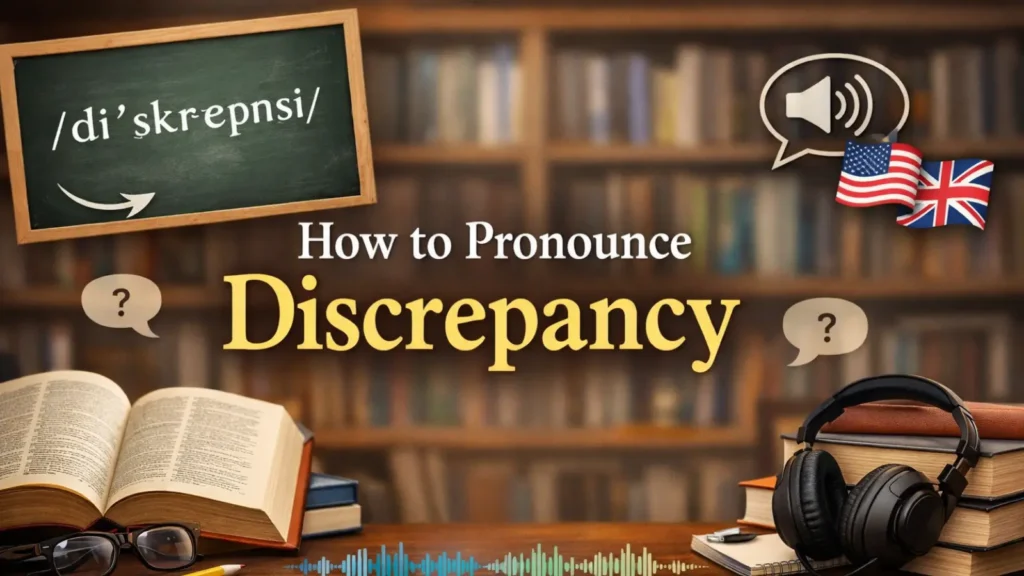
A simple pronunciation guide is:
dis-KREP-en-see
The stress falls on KREP.
Try saying it slowly first:
• dis
• KREP
• en
• see
A common problem is rushing the middle sounds. Keep the main stress clear, and the word becomes much easier to say.
When People Use the Word Discrepancy
People usually use discrepancy when they compare information that should agree.
Common contexts include:
• money and bills
• school records
• test results
• written reports
• legal statements
• business data
• medical forms
The word often appears when someone notices a mismatch and wants to point it out clearly.
Examples:
• There was a discrepancy between the invoice and the final bill.
• The teacher found a discrepancy in the attendance record.
• Police noted a discrepancy between the two statements.
How to Use Discrepancy in a Sentence

The word works best when you show what does not match.
Here are clear sentence models:
• We found a discrepancy between the order and the delivery.
• She noticed a discrepancy in the report.
• The manager asked us to explain the discrepancy.
• There are several discrepancies in these documents.
• A small discrepancy appeared in the total cost.
A common mistake is using it too loosely for any difference. It usually fits best when the two things are expected to match.
Better:
• There is a discrepancy between the receipt and the bank charge.
Less natural:
• There is a discrepancy between tea and coffee.
The second sentence sounds odd because tea and coffee are simply different. They are not expected to match.
Common Patterns and Collocations
Some word patterns appear again and again with discrepancy.
Useful patterns:
• discrepancy between A and B
• discrepancy in something
• notice a discrepancy
• explain a discrepancy
• resolve a discrepancy
• minor discrepancy
• major discrepancy
• apparent discrepancy
Examples:
• There is a discrepancy between the two totals.
• We noticed a discrepancy in the shipping record.
• Can you explain this discrepancy?
• The team resolved the discrepancy before filing the report.
These patterns make your English sound more natural.
Is Discrepancy Formal, Informal, or Slang?
Discrepancy is standard English. It is not slang.
It often sounds neutral to slightly formal. That is why it appears so often in reports, office writing, school writing, and official discussions.
You can still use it in daily speech, especially when talking about bills, records, or details that do not match. In very casual speech, many people simply say difference, mismatch, or something is off.
Discrepancy vs Difference vs Disparity
These words are related, but they are not always the same.
Difference is the broadest word. It can describe almost any way things are not alike.
Discrepancy is more specific. It points to a mismatch where agreement was expected.
Disparity often points to inequality or a large gap, not just a mismatch.
| Context | Best Choice | Why |
|---|---|---|
| Two totals should match, but do not | discrepancy | It shows a mismatch needing explanation |
| Two colors are not the same | difference | This is a general contrast |
| A large pay gap between groups | disparity | This stresses inequality or imbalance |
Examples:
• There is a discrepancy between the form and the database.
• There is a difference between blue and green.
• There is a disparity in access to care.
Synonyms and Antonyms
Close synonyms for discrepancy include:
• inconsistency
• mismatch
• variance
• disagreement
• difference
These words are close, but not always exact matches. For example, difference is broader, while mismatch is more direct and informal.
Possible opposites depend on context:
• agreement
• consistency
• match
• correspondence
There is not always one perfect opposite. The best choice depends on what is being compared.
Common Mistakes to Avoid
One mistake is using discrepancy for any simple contrast. The word works best when something should line up but does not.
Another mistake is confusing it with disparity. A discrepancy is usually a mismatch in details. A disparity is often a broader inequality.
Watch these examples:
Wrong:
• There is a discrepancy between summer and winter.
Better:
• There is a difference between summer and winter.
Wrong:
• The company studied the discrepancy in income levels across neighborhoods.
Better:
• The company studied the disparity in income levels across neighborhoods.
Also remember the plural:
• discrepancy
• discrepancies
Mini Quiz
- What does discrepancy usually describe?
- Is discrepancy a noun or a verb?
- Which sounds more natural: “a discrepancy between the two reports” or “a discrepancy between pizza and salad”?
- Is discrepancy slang?
- Which word fits a pay gap better: discrepancy or disparity?
Answer Key
- A mismatch between things that should match.
- It is a noun.
- “A discrepancy between the two reports.”
- No, it is not slang.
- Disparity usually fits better.
FAQ
What does discrepancy mean?
It means an unexpected difference between things that should agree. People often use it for facts, numbers, statements, or records.
How do you use discrepancy in a sentence?
Use it when something does not match as expected. For example: “There is a discrepancy between the receipt and the charge on my card.”
What is an example of discrepancy?
If a report says 25 items were shipped but only 23 arrived, that is a discrepancy. The numbers should match, but they do not.
Is discrepancy positive or negative?
The word itself is neutral, but it often appears in problem situations. That is because a discrepancy usually needs to be checked or explained.
What is the plural of discrepancy?
The plural form is discrepancies. Example: “The audit found several discrepancies.”
Is discrepancy a formal word?
It is mostly neutral to slightly formal. It is common in business, school, legal, and official writing, but people also use it in everyday speech.
What is the difference between discrepancy and disparity?
A discrepancy is a mismatch between things that should match. A disparity usually points to inequality or a larger gap between groups or conditions.
Conclusion
Now you know that discrepancy means a mismatch between things that should agree. It is a useful word for facts, figures, records, and statements that do not line up.
Keep an eye on context, and the word becomes easy to use. The next time you spot something that does not