
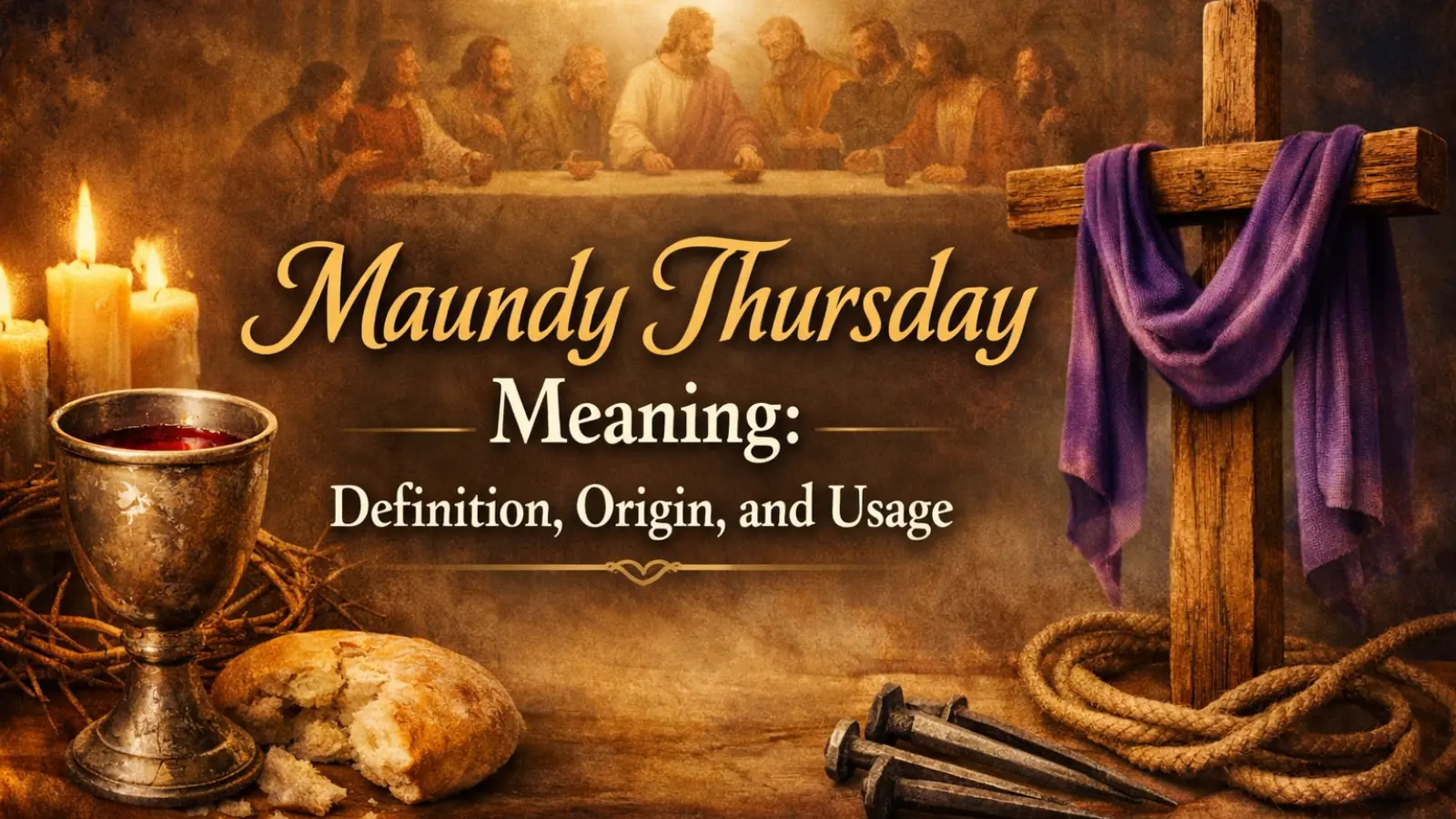
You may see the phrase Maundy Thursday around Easter, in church calendars, news stories, or school lessons about Holy Week.
For many readers, the name sounds unfamiliar at first. Some people even think it is a typo. It is not. It is a real English phrase with a specific religious meaning.
Maundy Thursday refers to the Thursday before Easter. Christians remember key events from the night before Jesus’ crucifixion, especially the Last Supper and the washing of the disciples’ feet.
This article explains what Maundy Thursday means, where the word comes from, how to pronounce it, and how people use the phrase in modern English.
Quick Answer
Maundy Thursday Meaning is the Christian observance on the Thursday before Easter.
The word Maundy comes from a Latin word linked to “commandment.” The phrase usually refers to the day Christians remember the Last Supper and Jesus’ command to love one another.
TL;DR
• Maundy Thursday is the Thursday before Easter.
• It is also often called Holy Thursday.
• Maundy is linked to “commandment.”
• The day recalls the Last Supper.
• Foot washing is a major symbol of service.
• The phrase is mostly used in religious contexts.
What Maundy Thursday Means in Plain English
In plain English, Maundy Thursday means the Thursday before Easter.
It is a Christian holy day. People use the phrase when talking about Holy Week, church services, and the final meal Jesus shared with his disciples.
A simple way to explain it is this: Maundy Thursday is the day that remembers the Last Supper and Jesus’ call to love and serve others.
What the Word “Maundy” Means
The unusual part of the phrase is Maundy.
In this context, Maundy is tied to the Latin word mandatum, which means commandment or command. The link is to Jesus’ “new commandment” to love one another.
So the name does not simply point to the day on the calendar. It also points to the message connected with that day.
That is why many explanations say the phrase means more than “the Thursday before Easter.” It carries the idea of love, humility, and service.
How Maundy Thursday Fits Into Holy Week
Maundy Thursday comes during Holy Week.
It falls after Holy Wednesday and before Good Friday. In many Christian traditions, it leads into the most solemn part of the Easter story.
Here is a simple guide:
| Context | Best Choice | Why |
|---|---|---|
| Talking about the Thursday before Easter | Maundy Thursday | Specific and traditional |
| Talking about the same day in many church settings | Holy Thursday | Common alternate name |
| Talking about the day after Maundy Thursday | Good Friday | Different observance |
This placement matters because the phrase is not a general word for Easter. It names one specific day.
What Happened on Maundy Thursday
When people ask what happened on Maundy Thursday, they usually mean the Bible events remembered on that day.
The best-known event is the Last Supper. This is the final meal Jesus shared with his disciples before his arrest.
Another major event is the washing of the disciples’ feet. This act is often understood as a picture of humility, care, and service.
Many Christians also connect the day with Jesus’ new commandment to love one another. Because of that, the meaning of the day is both historical and symbolic.
Some traditions also connect the evening with prayer, betrayal, and the events that lead into Good Friday.
Pronunciation and Part of Speech
Maundy Thursday is a noun phrase. It names a specific day.
A simple pronunciation guide is:
• Maundy: often said like MON-dee or MAWN-dee
• Thursday: THURZ-day
You would usually capitalize both words because they are part of a proper name.
Examples:
• Maundy Thursday is this week.
• Our church has a Maundy Thursday service.
A common mistake is to treat it like a general common noun and write it in lowercase. In standard English, it is usually capitalized.
How the Term Is Used in Modern English
Today, Maundy Thursday is mostly used in religious, educational, and cultural writing.
You may see it in:
• church bulletins
• school materials
• holiday calendars
• articles about Easter traditions
• news reports about Holy Week events
The phrase sounds formal and specific. It is not slang, and people do not usually use it in casual speech unless they are discussing Easter or church events.
In everyday American English, some people know Holy Thursday better than Maundy Thursday. Still, both names are widely understood in Christian contexts.
Maundy Thursday and Holy Thursday: Is There a Difference?
In most cases, Maundy Thursday and Holy Thursday mean the same day.
The difference is usually about wording, not meaning. Some churches, writers, or regions prefer one name over the other.
Maundy Thursday highlights the “new commandment” idea. Holy Thursday is often a broader church label for the same observance.
So if you read either phrase in an Easter calendar, it usually points to the Thursday before Easter.
Examples of Maundy Thursday in Sentences
Seeing the term in context makes it easier to understand.
• Maundy Thursday comes before Good Friday.
• The pastor spoke about service during the Maundy Thursday sermon.
• Many Christians remember the Last Supper on Maundy Thursday.
• Our school lesson explained why Maundy Thursday is also called Holy Thursday.
• The church held a Maundy Thursday communion service.
These examples show the normal pattern. The phrase is used as the name of a day, not as a casual expression.
Common Mistakes and Confusions
One common mistake is hearing Maundy Thursday as Monday Thursday. That is incorrect.
Another mistake is thinking the phrase means all of Easter. It does not. It names one day during Holy Week.
Some readers also assume maundy is a modern slang word. It is not. In this phrase, it is an older word with a religious background.
A final confusion is assuming Maundy Thursday and Good Friday are the same. They are different days with different meanings.
Related Terms, Synonyms, and Antonyms
A close synonym for Maundy Thursday is:
• Holy Thursday — usually the nearest equivalent
Related terms include:
• Holy Week
• Last Supper
• Good Friday
• Easter
• foot washing
• communion
There is no true everyday antonym for Maundy Thursday because it names a specific day. It is better to think of it as a fixed term, not an opposite pair.
Mini Quiz
Try these quick questions.
1) What day does Maundy Thursday happen?
2) What does the word Maundy connect to?
3) Is Maundy Thursday the same as Good Friday?
4) Is the phrase mainly casual slang or a religious term?
5) What is another common name for Maundy Thursday?
Answer Key
1) The Thursday before Easter.
2) A commandment, especially the “new commandment.”
3) No, they are different days.
4) It is a religious term.
5) Holy Thursday.
FAQs
Why is it called Maundy Thursday?
It is called Maundy Thursday because Maundy is linked to the Latin word mandatum, meaning “commandment.”
The name is commonly tied to Jesus’ “new commandment” to love one another.
What happened on Maundy Thursday in the Bible?
Christians remember the Last Supper on Maundy Thursday.
They also remember Jesus washing the disciples’ feet and the events leading to his arrest.
Is Maundy Thursday the same as Holy Thursday?
Usually, yes.
The two names normally refer to the same day in Holy Week.
What is the main purpose of Maundy Thursday?
Its main purpose is remembrance.
The day helps Christians reflect on the Last Supper, humble service, and Jesus’ call to love others.
How do Christians observe Maundy Thursday?
Observance varies by tradition.
Common practices include communion services, prayer, scripture reading, and sometimes foot washing.
Is Maundy Thursday a slang term?
No.
It is a traditional religious phrase, not slang.
Conclusion
Maundy Thursday Meaning is simple once you break it down.
It is the Thursday before Easter, and its name points to a commandment of love. If you see the phrase again, you will know both what it means and why it matters.